POST-INDUSTRIALISM / BRICKWORK PARK MILDENBERG


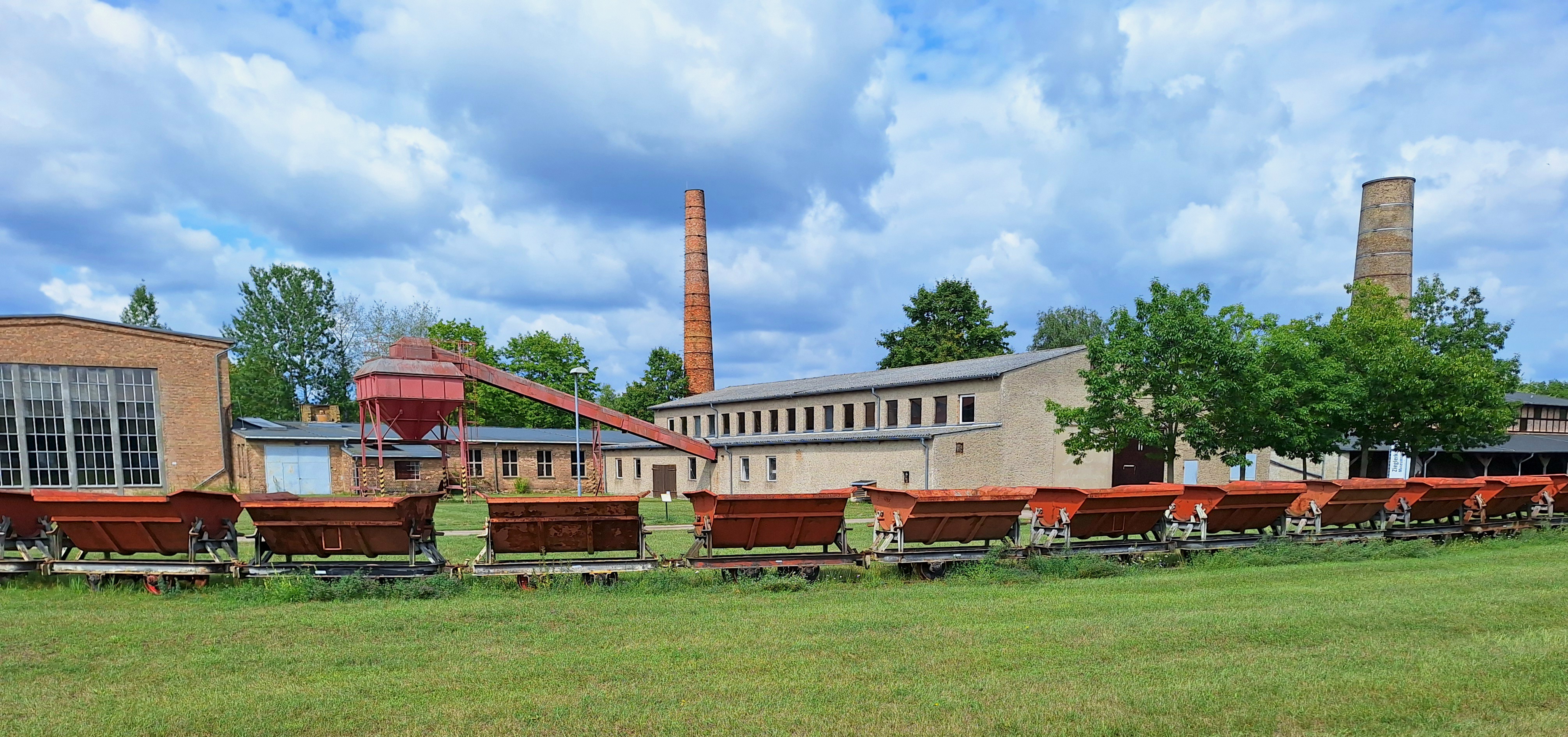
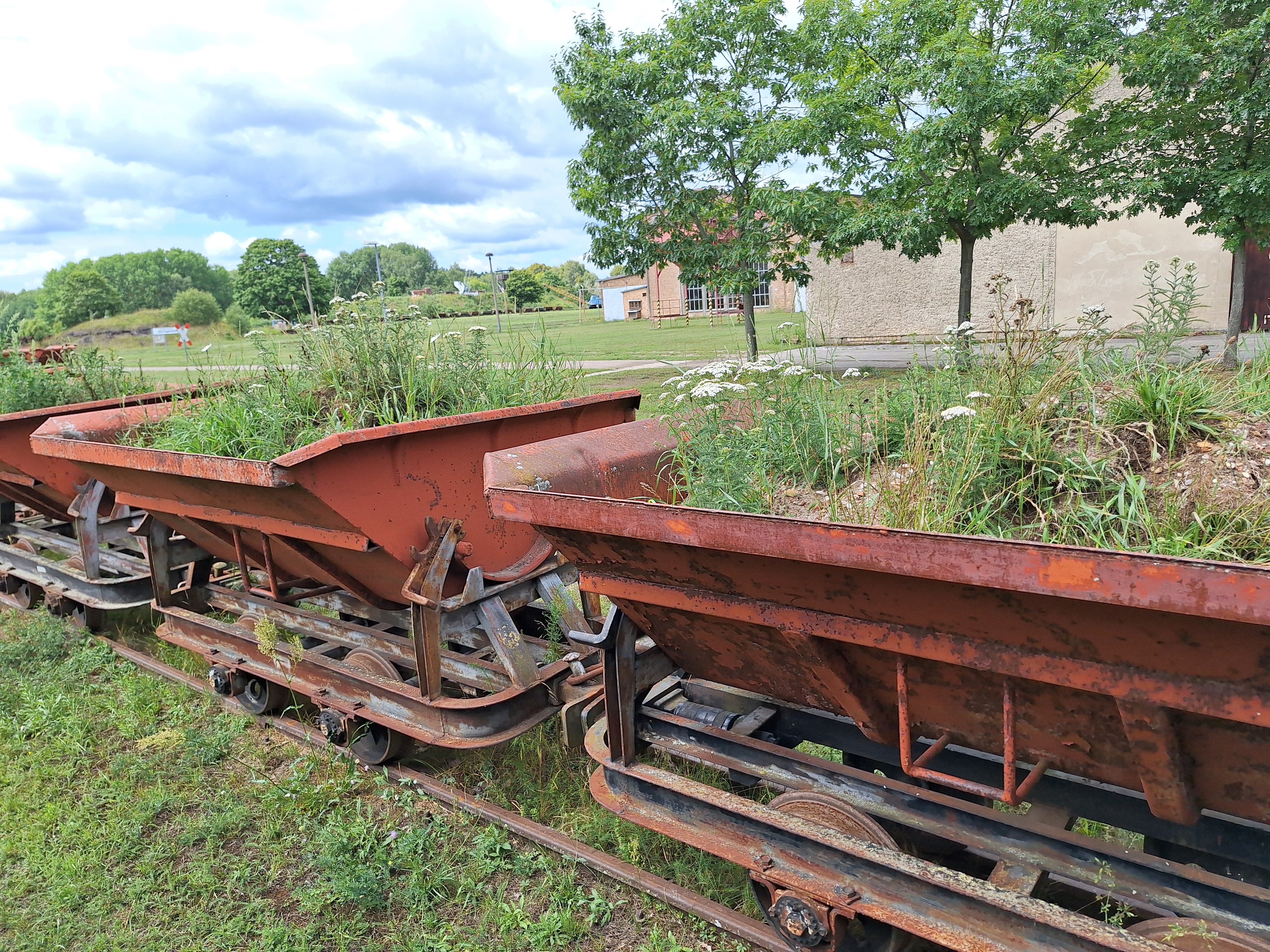
The Mildenberg Brickworks Park was once the largest brickworks in all Europe. Today it is an industrial museum and a popular excursion destination. Museum harbour, ring kilns, workshops and machine halls, everything can be visited. The site is in fact very large – so if you don’t want to walk around all the diverse stations, you can use optionally the free light railway..

Technology of early 20th century: a typical ring kiln

Miiildenberg Brickworks Park is located around an hour north of Berlin in the middle of the Zehdenick clay pit landscape. Brick production in the area dates back to 1887, when rich deposits of clay were discovered during the construction of the Löwenberg-Templin railway line.

The former industrial harbour with old barge and crane

Hence, at the beginning of the 20th century the huge bricksworks area was created near Mildenberg within a rather short period of time. The development was favoured by the fact that the clay quarries were located in the immediate vicinity of the Havel and thus offered favourable transport options by barge. Berlin, which was expanding rapidly due to immigration, had an enormous demand for building materials, which could now be met. The production peaked in 1910 at 625 million bricks a year, fired in 57 Hoffmann ring kilns. 

One of the many former clay pits being now beautiful lakes

Afrer 1945, the brick industry in the then Soviet occupation zone developed very well again. Reconstruction after the 2nd World War again required masses of building materials. In the GDR, the area around Mildenberg was the largest, now state-owned, manufacturer of bricks and roof tiles, until the introduction of prefabricated construction technology in the 1960s led to a renewed decline in importance. After reunification in 1991, operations were discontinued as investors saw no longer a future here.

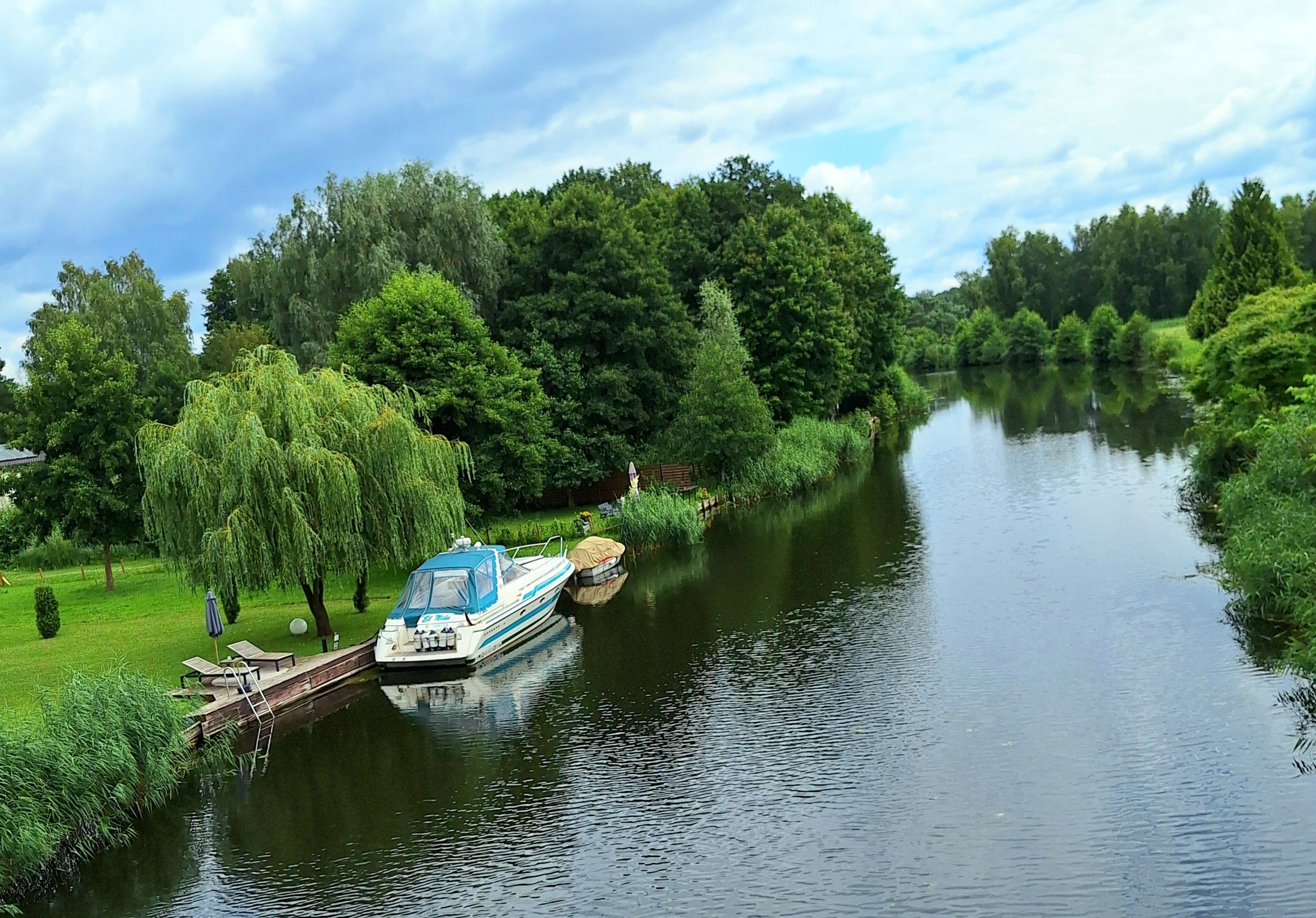
View on Havel river at Mildenberg winding to the south and Berlin

And now this blog will continue desirable summer holidays, cheers!

SECRETS OF A GARDEN

for Ingrid


Today, 80 years after the end of the bloody Second World War and the final liberation of Germany from disgusting and miserable fascism, I would like to write about a peaceful place with a special history. The fact that peace has prevailed in the heart of Europe for so long is, historically speaking, not really a self-evident matter. And unfortunately, one war often leads to another. This has been the case in Europe for centuries, with hundreds of wars in the last 500 years alone. And the current war in Ukraine is just as much a part of this, because it can also be seen as a direct successor to the Second World War, at least the Russian war narrative provides daily proof of this with the abstruse claim that the only thing being fought in Ukraine is against Nazis, while the current Ukrainian President Selensky is a Jew!

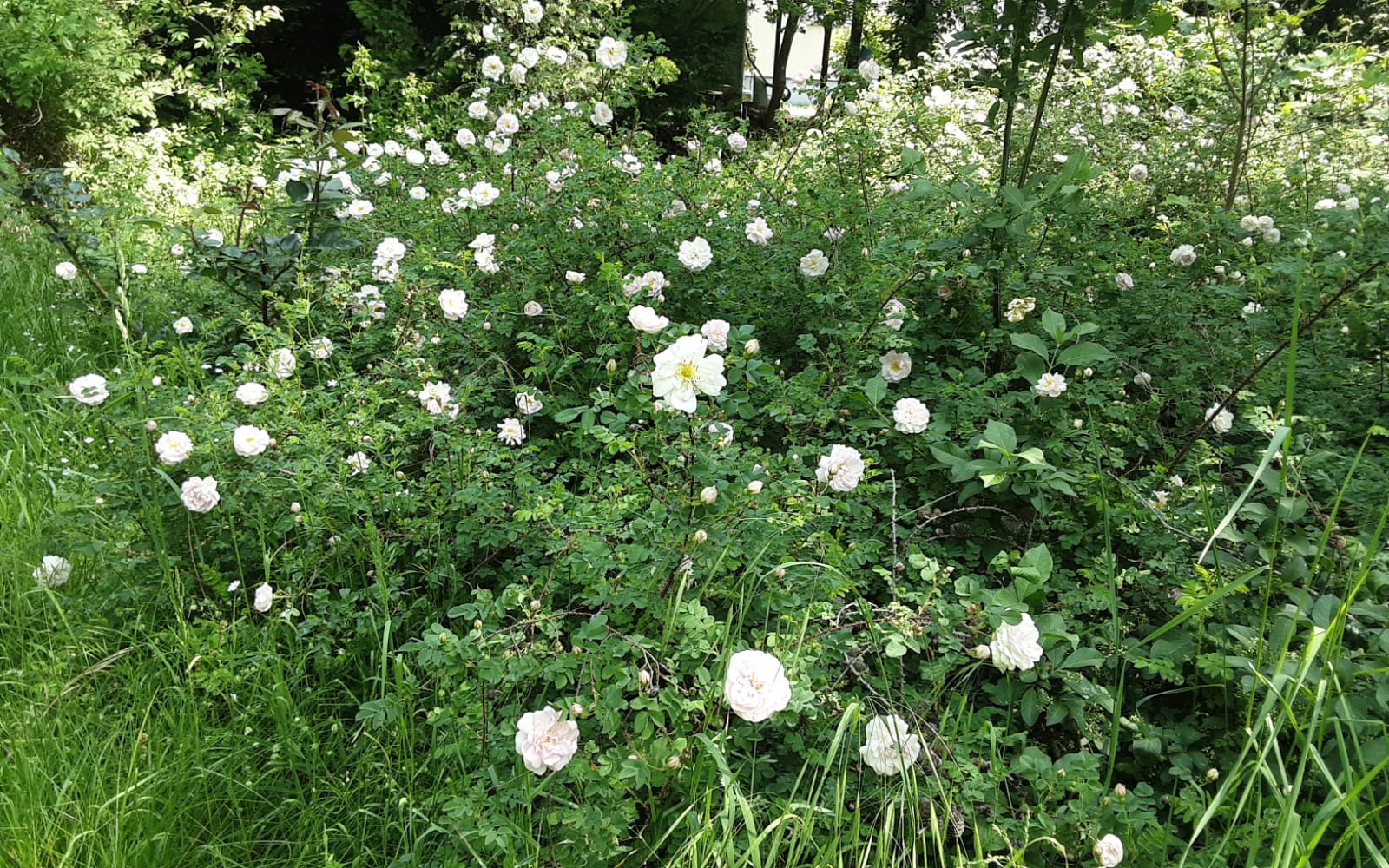
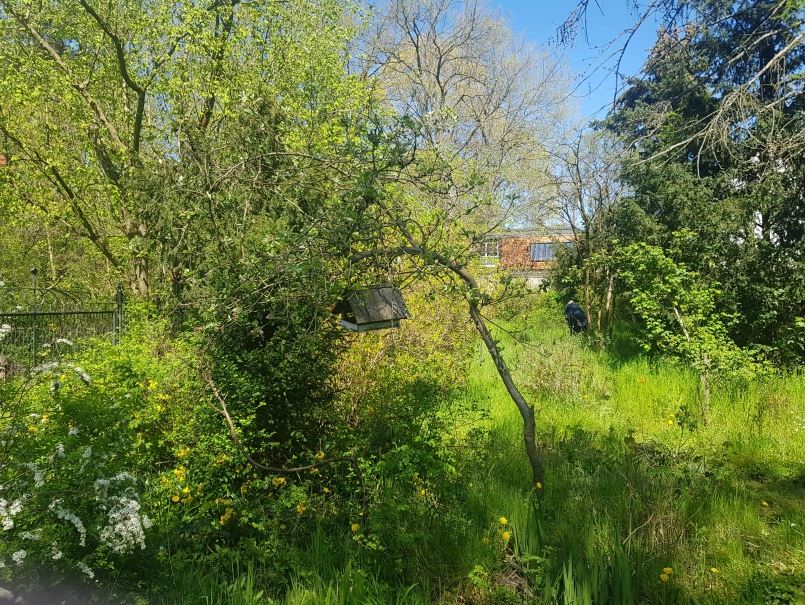
But here in the garden and in the whole country there is peace today, what happiness! But it’s not just a biotope like this that needs looking after. And this peaceful green idyll has been maintained for decades by a still very sprightly enthusiast called Ingrid, who is now 87 years old. However, she can no longer do as much as she used to, so things are getting wilder and more pristine here in her beloved garden. A storm knocked down birch trees in the garden many years ago, but there is nothing left to see of the old trunks and branches, as they have since been completely overgrown by all kinds of moss, grasses and plants, so that they have become one with the earth from which they once grew. So everything here has taken its usual natural course to the delight of insects and birds, who are offered a beautiful retreat with all kinds of hiding places in the very eastern part of Berlin.

In the 19th century, this was still a completely rural area, and for a long time this land also served as a gypsy camp far from the gates of aspiring Berlin. Towards the end of the 19th century, a senior forestry official of the Prussian government acquired this area and built a country house here, where he also carried out botanical experiments and planted rare trees on a trial basis, for example. This country house for the summer has survived all the historical turmoil and still stands here today. Probably for financial reasons, the forestry official then sold the property and house to a Jewish family in the early 1920s, who found a new home here for a while.

Hitler’s seizure of power in Germany in 1933 and the associated inhuman anti-Semitic rage of the Nazis in the country forced the Jewish family into exile in the USA and England. Fortunately, they did this very quickly in 1933, when it was still relatively easy for Jews to simply turn their backs on Germany. Ingrid’s parents, who were friends with the Jewish family, now moved into the old country house as tenants and also took care of all the formalities associated with the house. They acquired part of the property which today forms this fascinating garden. The country house itself was confiscated by the Nazis at some point and sold to a German master baker.

During the GDR era, this was then managed as a special asset and was only under communal administration (in the absence of the Jewish owners). In 1958, the Jewish family once again visited Germany, their old no-longer-home and also their friends here in the old country house. There was later still some correspondence across the ocean, which eventually dried up, but Ingrid’s family continued to live here on a rental basis until the early 1990s. Then, after the end of the GDR, the house was transferred back to the descendants of the Jewish family from the USA, who also came back to Berlin to the house of their ancestors for all the formalities. Thanks to legal documents and papers from the Weimar period that were kept here by Ingrid’s family, the restitution was relatively easy. However, the garden had been legally sold in 1933 and therefore remained in the possession of Ingrid’s family.

Here in the garden you can still find all kinds of relics of times long past, which are slowly disappearing into a new jungle. Today, there is a stumbling block on the sidewalk in front of the old country house, which commemorates the former Jewish residents of the house who were forced to seek their fortune in the big wide world far away.


MY NEAREST MOUNTAIN – CRAZY TEUFELSBERG IN BERLIN

Today, I would like to introduce you to the mountainous aspects of Berlin. Downtown there are of course some quite higher tops like Kreuzberg and Prenzlauer Berg which make me thinking of the funny film dealing about an English man who climbed on a hill and came down a mountain (that’s also the film’s title).

Postcard with view from Kreuzberg in 1866

But the nearest and more well-known elevation of Berlin is Teufelsberg / Devil’s Mountain in the huge municipal forest Grunewald and just 2 km distant from my home – even with rising sea levels a safe place due to an actual height of unbelievable 120.1 m, a location which also offers an interesting and surprising history.

Deceptive idyll on Teufelsberg in June 2018

Being geologically one of the youngest mountains worldwide, the 50th birthday of the location has just passed by, a critical age where a lot may change usually in the course of times as the following pictures of the site do clearly suggest.


Today Teufelsberg a center of urban art, the very last mutation of a bizarre place.

But let’s see what happened before here. At the end of WW II you would simply find a flat forest and the bombed rests of a big building formerly used by the German Wehrmacht as a military academy. This place was lying in the British sector of (West)-Berlin where no German army was allowed till the early 1990s when the special status of the city ended with the German unification. So nobody had any use for these military ruins left by the Nazis.

Ruins of Wehrtechnische Fakultät at Teufelsseechaussee

Vast areas of the town were also destroyed as a result of WW II, so this was declared as a place where all the debris and rubble of smashed houses would be brought till the late 1960s, in total 26 million cubic meters of waste material piled up to a new mountain getting the name Teufelsberg  because the site is lying at the road Teufelsseechausee leading finally to natural lake Teufelssee.

A truck transporting rubble to Teufelsberg, December 1951

Nature took quickly control of this dump, so today the mountain is covered by a wild nature and secondary forest. And the people of West-Berlin used the new mountain also for leisure like  snow sports as it was difficult to go elsewhere for quite long time due to the Wall of Berlin surrounding them till 1989.

Down the mountain’s not too long slope, December 1981

But the mountain has also been the last listening post of the Cold War. In the years 1968 the American army seized the complete top area of the mountain and erected till 1969 a radar and monitoring station for intelligence purposes such as controlling telephone conversations in the former German Democratic Republic. The secret name of these constructing and supervising ambitions was Project Filman. The last and fifth tower was built and finalized in 1989 shortly before the political transitions and opening of the Wall of Berlin. With the unificiation of Germany this complex was no longer required, the American army left the place in 1991 changing the area to a mere ghost town.

Path around the complex through the secondary forest, June 2018

Pioneer plants conquered the place in the time being which grew in the cracks of the asphalt and even settled on roofs. Undemanding plants such as the evening primrose, the stonecrop or the elder have laid the groundwork that it is today very green on top of the Teufelsberg. The complex was sold to an investor who planned a hotel and luxury appartments on the mountain. But after getting many millions of loan for the project from the banks, he was never seen again in the city. Some years ago this area has also been declared as forestrial land making impossible such luxury projects in the future. 

One of the decaying radiation domes, August 2019

The abandoned and still militarywise fenced place attracted of course the urban art and graffiti community. So in the ruins you find today a vast diversity of amazing colorant works of any kind. The domes can no longer be visited due to their bad conditions, but the unique complex is huge and can be visited against payment of an entrance fee. Meanwhile another change, the city awarded this wild site the relevant status of a real protected monument. So history can be just fabulous sometimes!

Colorful wildness of the ruins, August 2019