THE WEIRD STORY OF THE FIRST GERMAN MOSQUE


Completely by chance I stumbled on the above 100 year old postcard image, which made me curious to know what it was all about, because a mosque somewhere in the vastness of the Mark Brandenburg I had never seen before. The postcard shows parts of the so-called Half Moon Camp in Wünsdorf including the camp’s own mosque.

The Half Moon Camp was built at the beginning of WW I in what was then Wünsdorf near Zossen as a camp for about 30,000 Muslim Arabs, Africans and Indians (but also Hindus and Sikhs) prisoners of war who were sent from the colonies as part of the British and French armies in 1914/1915 to fight in the merciless and man-eating trench and position warfare on the Somme and elsewhere.

Former site of the camp/mosque in Wünsdorf

In addition to the inmates of these two colonial armies, however, Muslim members of the Imperial Russian Army were also interned there. In the Crescent Camp itself, active attempts were now being made to persuade the prisoners of war detained there to switch sides as part of a Muslim ‘holy war’ against the two colonial powers, England and France, “in order to wage a kind of guerrilla warfare with local rulers and tribal lords, thereby tying up as many English and French troops as possible, who would then be missing from the European battlefield.” (1)

Recreation and food distribution in the Wünsdorf Crescent Camp around 1915

At the request of the Mufti of Constantinople, therefore, the wooden mosque pictured above was also built in the camp in 1915 (the first mosque ever built in Germany). This was “supplemented by visits and speeches, especially by Turkish, Tatar and Arab politicians and journalists, who sought to influence the prisoners not only in the sense of German-Ottoman brotherhood in arms and pan-Islamic solidarity.” (2) In addition to the daily briefings, there were also propagandistic camp newspapers in several languages; besides, special attention was paid to the strict observance of Muslim rules (e.g. fasting during Ramadan). However, there is no doubt as to how many camp inmates actually changed sides.

From a historical point of view, this strategy – pushed on the German side by the orientalist and diplomat Max von Oppenheim – is in any case nothing new. “Already the legendary Muslim ruler Saladin had repeatedly entered into alliances with the Franks against rival Muslims or Christians. … The Ottoman Empire had called for holy war in most, not to say all, of the military conflicts in its history.” (3) As a relic of this dubious past in Brandenburg, however, only the Indian cemetery of Zehrensdorf can be found today; nothing remains of the Half Moon Camp itself except the street name Moscheestr. in today’s community of Waldstadt (district of Zossen), a road leading to the former site of the Half Moon Camp mosque, but today a postmodern wasteland.

Indian relief on the cemetery in Zehrensdorf

Finally, located outside of Zossen about 500 meters off the L74 highway in a wooded area is the cemetery of honor for the 206 Indian soldiers of the Half Moon Camp who died in captivity. This final resting place was rededicated in 2005 as the Zehrensdorf Indian Cemetery in the deserted area of the former Zehrensdorf. Also on the grounds is a memorial and grave marker for the Muslim Tatars from Russia who died here on site.

A bronze memorial plaque at the entrance to the Indian cemetery reads in German and English that the Indian soldiers buried here fell for their country, and that is a bit cynical, because no German, Austrian or Ottoman soldier ever set foot on Indian soil during World War I or before or after to cause trouble there or even to occupy this faraway land. And who would want to die far from home in a completely senseless war? And so it is not surprising that in the former colonies of Morocco, Algeria, Tunisia, India, Pakistan and Singapore there was great resistance and also real uprisings against the war effort in faraway Europe, which was, however, ruthlessly suppressed everywhere by the colonial powers. And without these colonial troops (especially those from India) the course of the war would have been different.
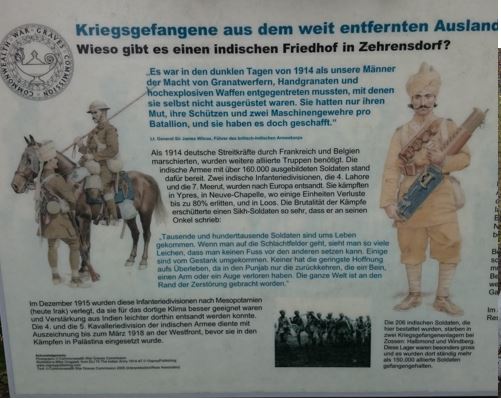
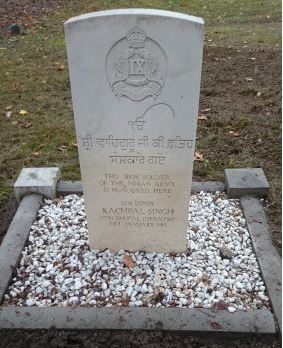
Indian single grave at the cemetery in Zehrensdorf

The cemetery is very well maintained and it is good that there are these places of remembrance, where a critical examination of history can take place. During my visit, gardeners were busy removing the traces of autumn, I also noticed many new individual gravestones, but it is a rather remote and somehow forgotten place in the vastness of the Mark Brandenburg hemmed in by the typical Mark Brandenburg pines and forests. So how often do visitors really get stranded here? I saw only a few traces of visitors, withered remains of memorial wreaths that are probably laid there once a year. The slightly foggy and hazy weather and the cold and damp wind of Autumn exactly matched these irritating alien impressions of another era.


(1)  Loth/Hanisch (Hrsg.), Erster Weltkrieg und Dschihad, München 2014, S. 15
(2)  Gerhard Höpp, Muslime in der Mark, Berlin 1997, S. 73
(3)  Stefan M. Kreutzer, Dschihad für den deutschen Kaiser, Graz 2012, S. 61
 

SECRETS OF A GARDEN

for Ingrid


Today, 80 years after the end of the bloody Second World War and the final liberation of Germany from disgusting and miserable fascism, I would like to write about a peaceful place with a special history. The fact that peace has prevailed in the heart of Europe for so long is, historically speaking, not really a self-evident matter. And unfortunately, one war often leads to another. This has been the case in Europe for centuries, with hundreds of wars in the last 500 years alone. And the current war in Ukraine is just as much a part of this, because it can also be seen as a direct successor to the Second World War, at least the Russian war narrative provides daily proof of this with the abstruse claim that the only thing being fought in Ukraine is against Nazis, while the current Ukrainian President Selensky is a Jew!

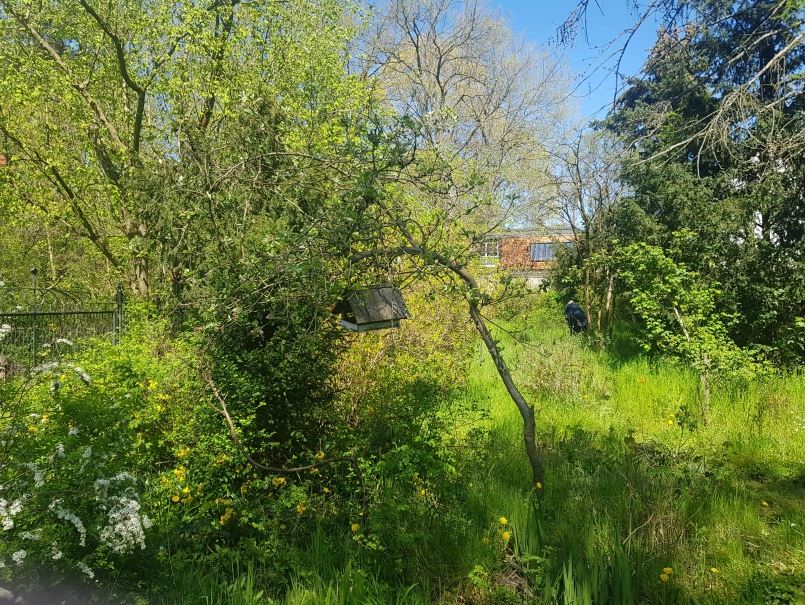
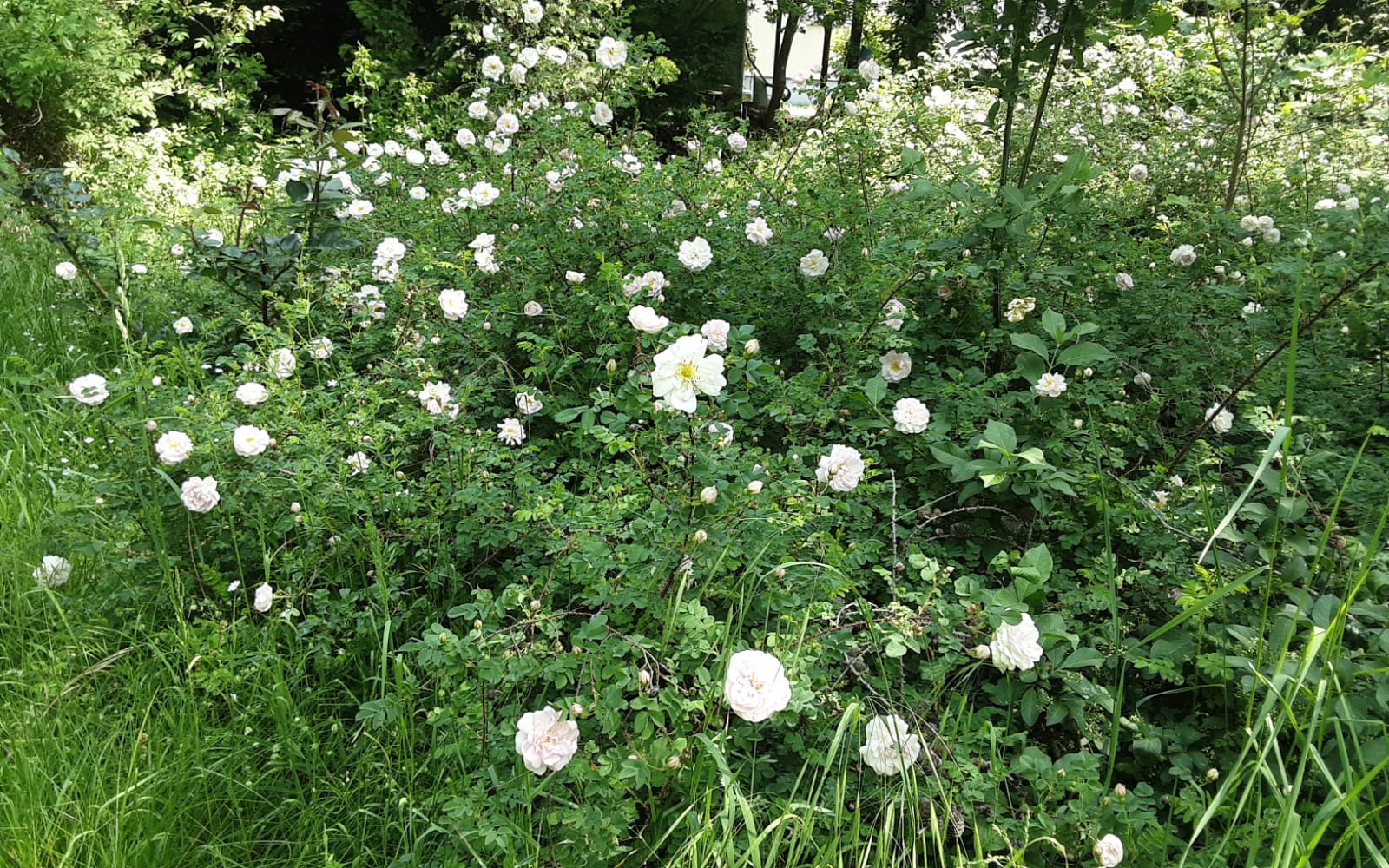
But here in the garden and in the whole country there is peace today, what happiness! But it’s not just a biotope like this that needs looking after. And this peaceful green idyll has been maintained for decades by a still very sprightly enthusiast called Ingrid, who is now 87 years old. However, she can no longer do as much as she used to, so things are getting wilder and more pristine here in her beloved garden. A storm knocked down birch trees in the garden many years ago, but there is nothing left to see of the old trunks and branches, as they have since been completely overgrown by all kinds of moss, grasses and plants, so that they have become one with the earth from which they once grew. So everything here has taken its usual natural course to the delight of insects and birds, who are offered a beautiful retreat with all kinds of hiding places in the very eastern part of Berlin.

In the 19th century, this was still a completely rural area, and for a long time this land also served as a gypsy camp far from the gates of aspiring Berlin. Towards the end of the 19th century, a senior forestry official of the Prussian government acquired this area and built a country house here, where he also carried out botanical experiments and planted rare trees on a trial basis, for example. This country house for the summer has survived all the historical turmoil and still stands here today. Probably for financial reasons, the forestry official then sold the property and house to a Jewish family in the early 1920s, who found a new home here for a while.

Hitler’s seizure of power in Germany in 1933 and the associated inhuman anti-Semitic rage of the Nazis in the country forced the Jewish family into exile in the USA and England. Fortunately, they did this very quickly in 1933, when it was still relatively easy for Jews to simply turn their backs on Germany. Ingrid’s parents, who were friends with the Jewish family, now moved into the old country house as tenants and also took care of all the formalities associated with the house. They acquired part of the property which today forms this fascinating garden. The country house itself was confiscated by the Nazis at some point and sold to a German master baker.

During the GDR era, this was then managed as a special asset and was only under communal administration (in the absence of the Jewish owners). In 1958, the Jewish family once again visited Germany, their old no-longer-home and also their friends here in the old country house. There was later still some correspondence across the ocean, which eventually dried up, but Ingrid’s family continued to live here on a rental basis until the early 1990s. Then, after the end of the GDR, the house was transferred back to the descendants of the Jewish family from the USA, who also came back to Berlin to the house of their ancestors for all the formalities. Thanks to legal documents and papers from the Weimar period that were kept here by Ingrid’s family, the restitution was relatively easy. However, the garden had been legally sold in 1933 and therefore remained in the possession of Ingrid’s family.

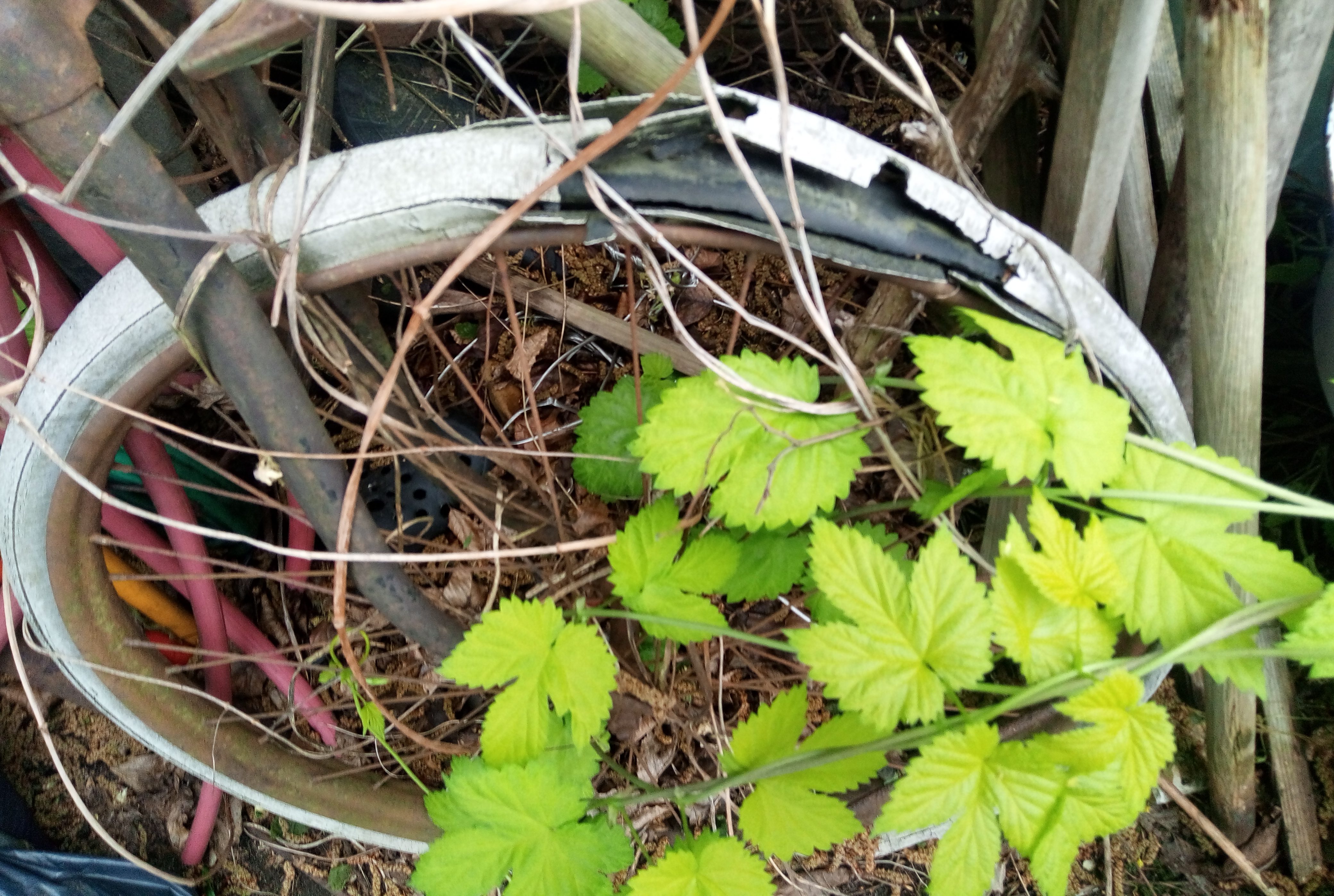
Here in the garden you can still find all kinds of relics of times long past, which are slowly disappearing into a new jungle. Today, there is a stumbling block on the sidewalk in front of the old country house, which commemorates the former Jewish residents of the house who were forced to seek their fortune in the big wide world far away.


TWILIGHT OF THE POPULIST IDOLS

A malignant spectre is again creeping across the streets of Europe, it is the ghost of simplistic truths and self-appointed saviours of the West as a whole. The nationalist ideologies of the 19th and 20th centuries are on their way to a sickening revival in many countries.

Hitler, Stalin and Co. at Nordart Exhibition 2018
The responsible politicians – harmlessly called populists – have started a postmodern witch hunt, the victims of this undeclared war are now refugees, foreigners or people of other faiths and lifestyles. The globalisation of this retrograde zeitgeist has opened up new battlefields where peace should actually reign.

Winning the Arms Race in Red Square, Carl Chaplin, 1986
These ruthless ideologues want to turn back the clock, which risks reheating old, already forgotten conflicts. Like unscrupulous sorcerers’ pupils, the radical nationalists have lit blazing fires and pyres all over Europe and elsewhere that urgently need to be put out again. Poland has just shown and proven by the national election of October, 15, 2023, that this is possible and feasible – a great significant step and symbolic signal!
**********************


Phillip Boa & The Voodoo Club, And Then She Kissed Her – 2010
*****************

ALIENS UND DER UKRAINE-KRIEG HEUTE

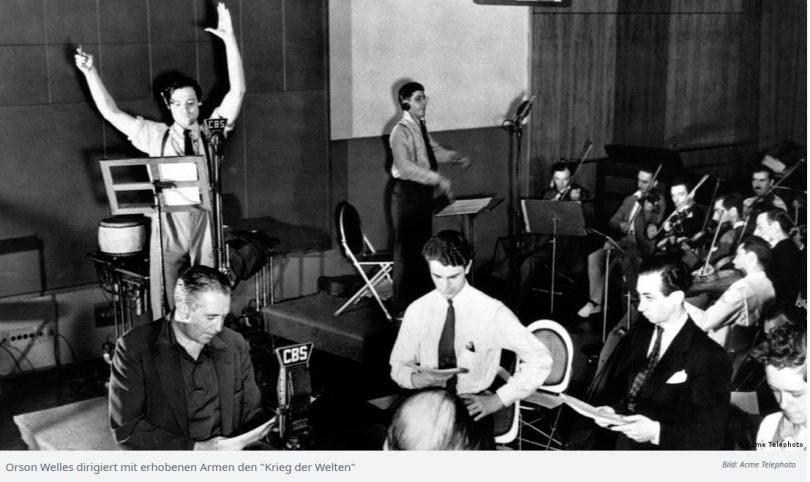
“Fake News” sind nicht neu: Vor 80 Jahren sorgte ein angeblicher Radiobericht von einem “Krieg der Welten” in den USA für Aufregung – und löste damals eine große Debatte über Medienkompetenz aus. In Anlehnung an das Buch von 1898 wurde bereits 1938 ein Radiohörspiel von Orson Welles gesendet, in dem die Panik und Emotionen der Menschen sehr authentisch vermittelt wurden.

Steven Spielberg konnte das Original-Script des Autors (Howard Koch) des Hörspiels erwerben. Schon 1953 wurde ein Film unter dem Titel Kampf der Welten von Byron Haskin inszeniert, von dem Spielberg zentrale Passagen und Motive übernimmt, so dass Krieg der Welten neben der Literatur-Adaption auch als Neuverfilmung von Kampf der Welten bezeichnet werden kann.

Und sie lebt weiter die Angst vor den Außerirdischen in unzähligen Büchern und Filmen. Auch die vermeintlichen oder vielleicht auch echten UFO-Sichtungen sind ein Beispiel für diesen modernen Archetyp, Science Fiction als zeitgemäßer Mythos, denn das Irrationale war ja immer ein wesentlicher Wesenszug des homo sapiens. Die Vernunft ist nicht allen Menschen gegeben, davon künden auch alle Kriege dieser Welt bis heute; und der Ukraine-Krieg reiht sich ein in eine Abfolge immer wiederkehrender archaischer Verhaltensmuster.

Mine und Edgar Wasser, Aliens, live in Berlin

Es stellt sich die Frage, ob die Menschheit so eine Zukunft und Perspektive hat; denn echte Lehren wurden nie aus der Geschichte gezogen, dann müsste unsere Welt heute anders organisiert sein und funktionieren. Wie Diplomatie funktionieren kann, war schon vor rund 400 Jahren bekannt. Der Westfälische Frieden von 1648 beendete einen dreißigjährigen Krieg hier in Deutschland und Zentral-Europa.

Dies war der schäbige Weltkrieg des Mittelalters, und ein deutsches Trauma bis zum heutigen Tage. Langwierige und komplizierte Diplomatie schuf damals Frieden, dies wäre auch heute sehr wünschenswert an vielen Orten dieser Erde.

AFTER DADAISM, MAILISM COMES TOURISM

Mailart – a subversive form of expression

Stampart on envelope, Hans-Ruedi Fricker,,Switzerland, 1986
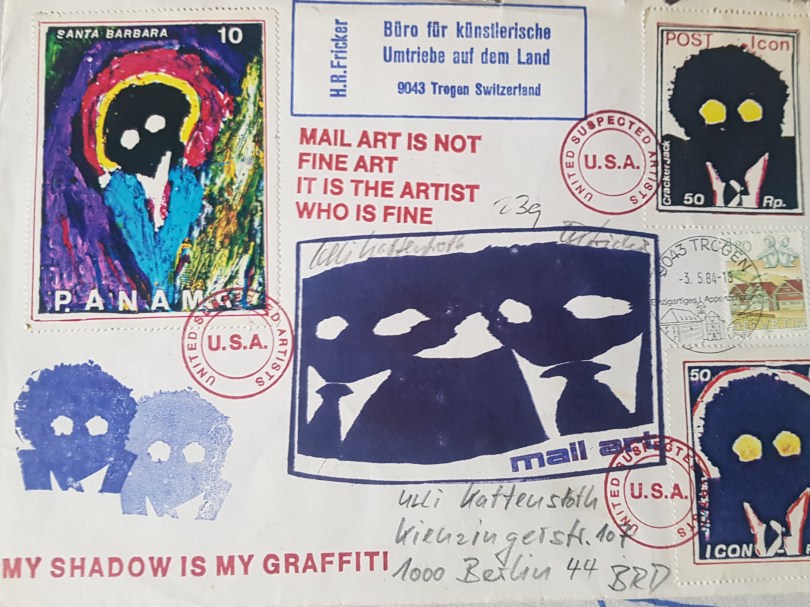
I am very thankful that I was in touch with Hans-Ruedi for many years by mail. And in the 1980s I also visited him at his creative office in Trogen. Me and my wife were his family’s guests in this nice alpine region “Appenzeller Land”. We were just tourists looking for leisure and trying to learn a little bit more about Switzerland.

Yummi! Monstrous windbags enjoyed at Cafe Seeblick, Alt-Globsow, Germany, July 7 2023

And yes, Hans-Ruedi was completely right, tourism is just as important as mail-art. Both bring people from other countries together for a better understanding of our nice blue planet and such securing peace here in Europe and everywhere on Earth.

Programmatic messages by mail, Hans-Ruedi Fricker, Switzerland, 1983
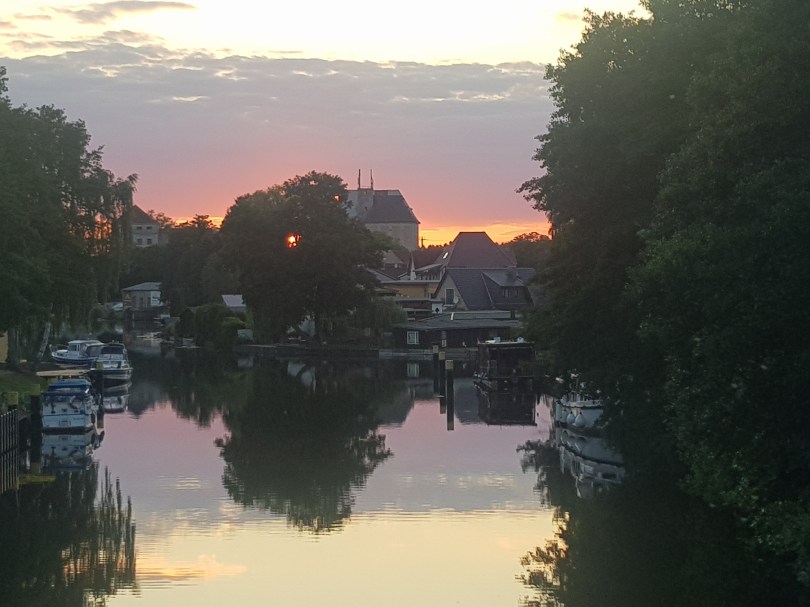
P. S.  I am writing all this as a mere tourist while being some days in the very nice and natural green old village of Alt-Globsow, Mark Brandenburg, Germany

Sun-set at Fürstenberg with Havel river, Germany, July 6, 2023

L