TUNISIA – WATER, DESERT AND NOMADIC VASTNESS

It doesn’t matter if the road is long, as long as there is a well at the end. (Tuareg proverb)


“A Street in Gadames” by Giorgio Oprandi, 1929.

Water is our cool elixir, which unfortunately is not available everywhere in the world. But as climate change progresses, desert and semi-arid areas around the world will expand even further, while countries like Spain or Italy are already experiencing water shortages in summer.
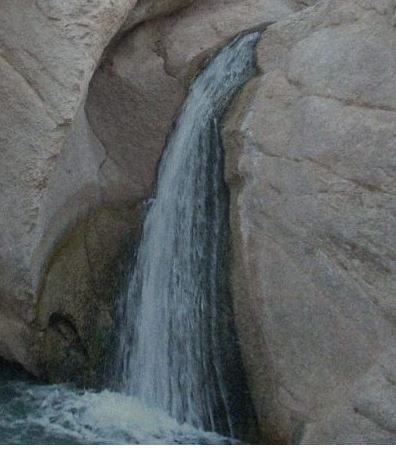
Here the water still gushes abundantly in the mountain oasis of Tamerza

From the main road between Tabarka and Bizerte we had to drive 15 km over deserted sandy roads to reach Cape Negro, a forgotten and abandoned place on the Mediterranean coast with typical vegetation, a rather cool wind from the sea and also a long sandy beach without other people, there in the area you can also still find the typical cork oak forests.
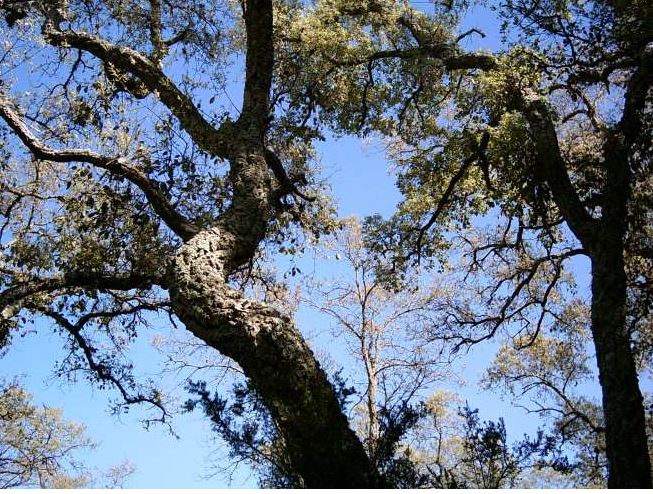
Cork oak in a forest near Tabarka not far from the Algerian border
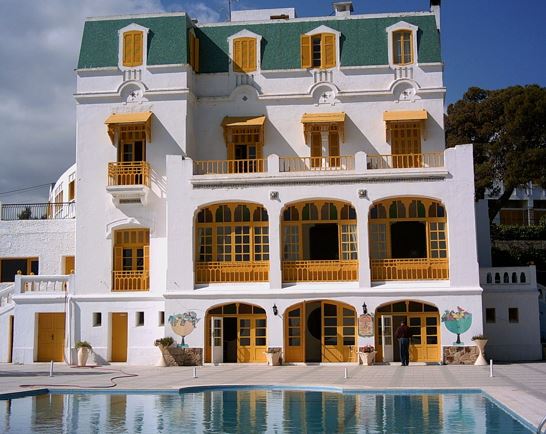
“Hotel Les Mimosas” in Tabarka

Doesn’t this hotel really look very French? The beautiful place is situated on a small hill and offers a beautiful view of Tabarka and the sea.
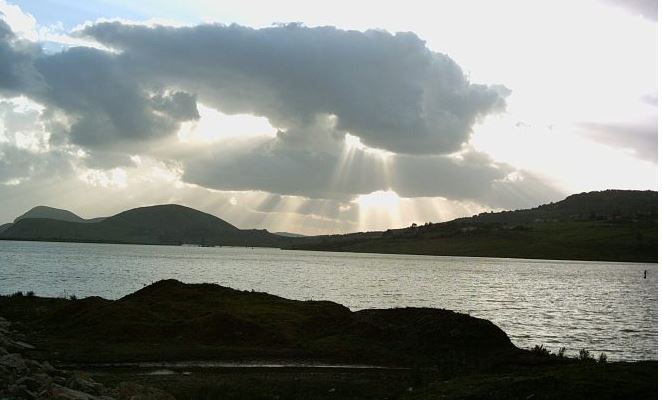
Sidi-el-Barrak water reservoir near Nefza

This reservoir in the very green north of Tunisia is also a completely untouristy place, but at this moment in the late afternoon, the mood and the interplay of light, clouds and water revealed something different.
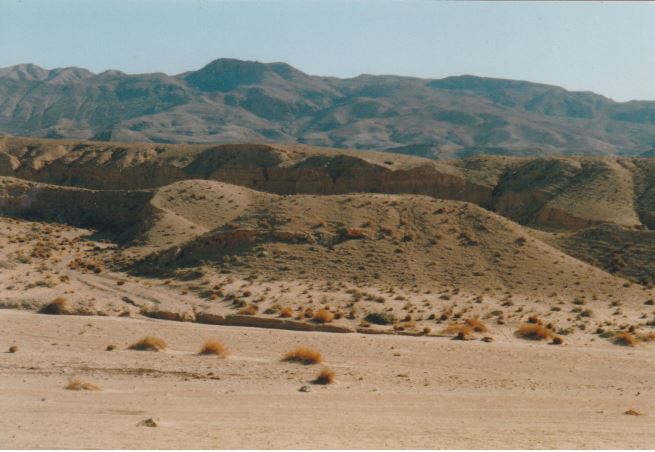
The Atlas massif divides Tunisia, and the great Sahara begins at its southern edge.

Consider that 2,000 years ago, Tunisia was still the granary of the Roman Empire. Since then, the warm period after the last ice age and normal climate change have transformed formerly very fertile areas into vast wastelands and endless desert zones. And the Sahara has not stopped its unchecked expansion to this day.

Cracked desert between Tozeur and Tamerza, Sahara

This photo remains one of my favourite travel memories from Tunisia and shows a single hardy bush in an area of cracked and parched ground, probably due to very rare and heavy rains some time ago.
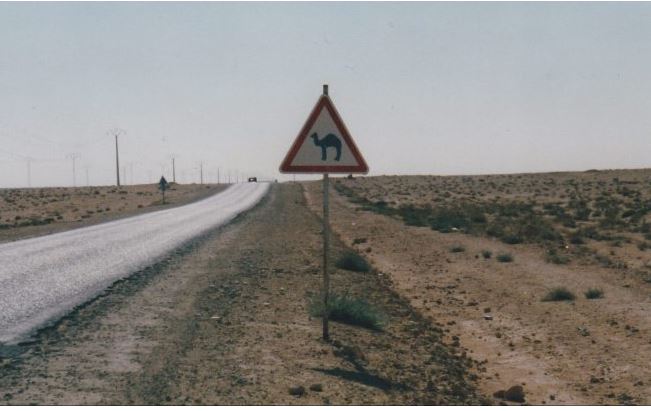
But where are the legendary dromedaries? Not a single one here.

The photo was taken on the main road coming from the north and Tunis, which is now really deep in the south somewhere between Metlaoui and Tozeur.

The cave dwellings of Matmata, also known as the home of Luke Skywalker in Star Wars.

Halfway between Tozeur and the Djerba Peninsula lies the cave village of Matmata, where people have lived for millennia and which was made wellknown by the famous cult film series Star Wars. The landscape is quite barren with only a few dwellings on the surface, but the magic of Matmata goes deeper and reveals itself to guests when they descend into the unique underground cave dwellings, which offered their inhabitants good protection from extreme cold at night and the burning sun during the day.

Arab Scene in Tunisia, Ernesto Quarti Marchio, 1933

Small paradise and tiny water well near the Douz oasis.

The Sahara desert used to be a vast sea where nomads made their endless sailing trips on dromedaries (not camels), some still do. Nevertheless, I really appreciate the desert (as well as high mountains) as a very purist place with a clear, unlimited view to the distant horizon that can clear your mind and broaden your horizons, a really exciting feeling besides all the known dangers and risks.
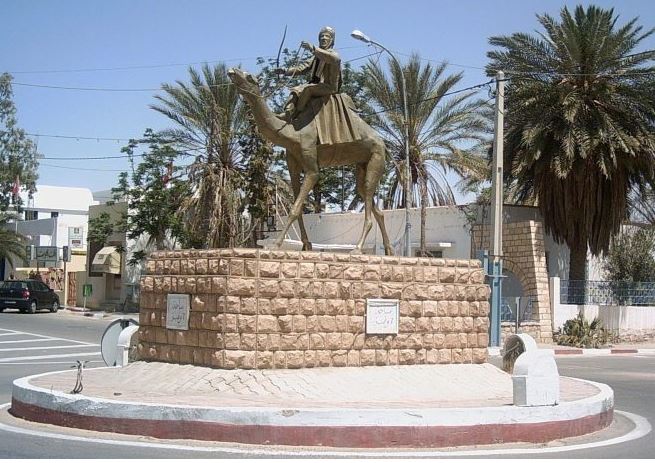
Nomadic monument at a road junction in Douz.

The oasis of Douz is a real gateway to the Sahara and today has about 30,000 inhabitants. The desert dunes near Douz are famous because they consist of an incredibly soft and almost white sand. The area is traditionally inhabited by the semi-nomadic Mrazig tribe, an Arab Bedouin tribe that left the Arabian Peninsula in the 8th century and settled in Tunisia in the 13th century. Today, many make their living from date harvesting, and probably the best dates in Tunisia come from Douz, called Deglet en Nour. The “gold of the oasis” is therefore more than just any fruit for the inhabitants of Douz.

Death zone of the huge salt lake Chott-el-Jerid after sunset.

Today, the huge salt lake Chott-el-Jerid can be crossed safely on a solid dam with a road that also connects the oasis areas of Nefzaoua and Tozeur. In the past, such a journey was a dangerous adventure.

Not suitable for drinking – only the salty water of Chott-El-Jerid
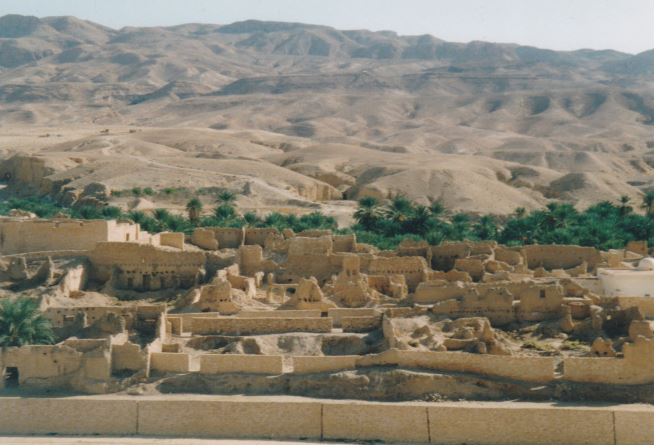
Ruins of the ancient city and mountain oasis of Tamerza

Now this trip here has really become more of a collage of texts, impressions and diverse pictures collected from various places in the vast and beautiful Tunisia.

Breakfast with fresh flower blossoms in the oasis of Tozeur

International Festival of Sahara at Douz 2019

****************


EGYPT – TO THE OASIS OF SIWA VIA MARSA MATRUH

“A sense of humor is the pole that adds balance to our steps as we walk the tightrope of life.”  (Arabic proverb)

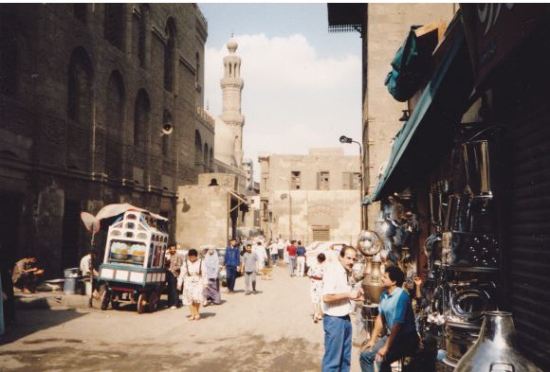
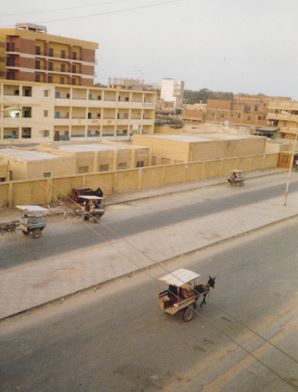
A very mythological place in Egypt is the Oasis of Siwa which was not so easy to reach in 1985. From Alexandria I took a regional bus to the small town of Marsa Matruh being situated at the coast not far away from the Lybian border in the very West. On the photo above and hereunder you see a typical street-scene with a donkey cart and of course the old bazaar there. But I had to stay in this town in order to get a special permission from the local authorities for visiting the Oasis of Siwa (being also a military’s exclusion zone), this alone took me around 2 days. It is a rural area, just normal life and more unspectacular except one very strange and bizarre exhibition on the outskirts of Marsa Matruh.

I am quite sure that this must be the only place in the world where a museum honours the Nazi general Erwin Rommel with the still existing Rommel’s Cave Museum (see photo hereunder). Just before Rommel’s Beach is the cave system where Rommel planned the axis forces’s military operation during WW II. The caves are now home to a small museum that displays some of his personnel effects and the maps he drew up here presenting him as a hero. The Egyptians did not like very much to be part of the British Empire while their great hope to become independent after WW I was not respected by the colonial powers at Versailles. So the Egyptians appreciated when the German Wehrmacht invaded Northern-Egypt in the naive hope for a principal change of their fate after being first occupied by the Osmans for long time and then later by the British. And they especially admired the combat strategy of Rommel in North-Africa standing in the tradition of the Bedouins. Although Rommel committed suicide in October 1944 due to imminent punishment after an officer’s rebellion against Hitler, this place made me dazzled and speechless however as the complete museum did simply ignore the devastation of great parts of Europe, the holocaust and the millions of other deaths as a result of Nazi-German cruelties (27 millions dead people alone in the former Soviet-Union).

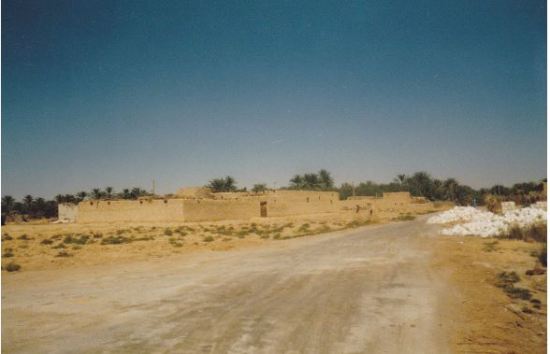
After this unexpected historical abyss, I was happy to leave Marsa Matruh for my visit of the Oasis of Siwa which was also reachable by a daily bus through the Lybian desert. On the way to Siwa a lot of military vehicles could be seen because the Egyptian army held some military compounds in the oasis. Those days the crazy colonel Muammar Ghaddafi was the revolutionary head of the Lybian state, and the Egyptians simply did not trust him. Therefore, the whole territory stood under special military’s control. The street to Siwa was not in the very best condition but this is nothing unusual in a desert with great differences in temperature from day to night. It took around 3.5 hours with the bus from Marsa Matruh to Siwa, so I did arrive in the early afternoon when it was really hot, not surprisingly hardly anybody on the streets of Siwa upon my arrival.Not far away from the bus station I found a rather simple hotel in the oasis, I think it was the only one, but it offered good protection against the burning sun and strong heat, what was the most important here. The breakfast and meals were of more modest character, and in the oasis in general a mediaval feeling struck my mind as if being hardly put back in time.

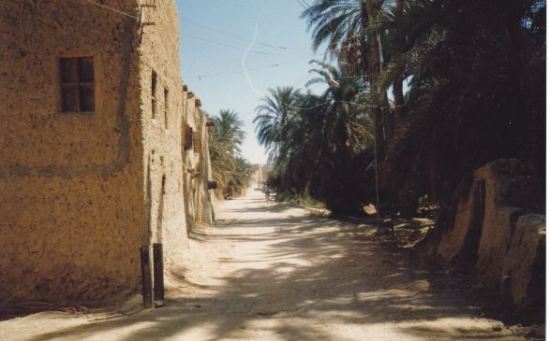
The oasic region of Siwa is the only place in Egypt with a Berber population (ca. 23,000), culture and language called Siwi. It is lying in the Qattara depression around 18 m under sea-level, therefore water finds very easily its way to the surface being the basis for life in a desert. The agriculture of Siwa comprises mainly the massive production of dates and olives but as well also diverse vegetables for daily life and local consumption. So vast areas are simply covered by the evergreen date palm-trees.

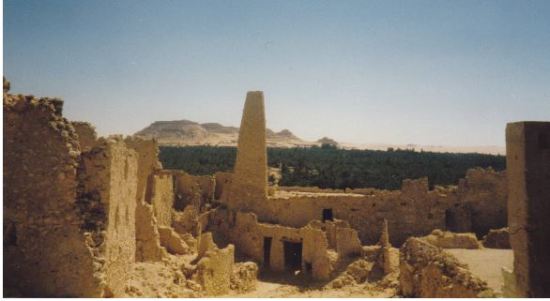
The history of the oasis can be followed back in history till the 18th Pharaonic dystany (1,500 B.C.). At that time the climate was much better and North-Africa much greener, hence the Egyptians erected here an important Temple of Amun – a location with a very well-known oracle. Even Alexander the Great made use of this powerful oracle of Siwa and upon his visit was welcomed as the true sun of Zeus. The next two photos show the debris and ruins of the Temple of Amun in Siwa.

The course of time created surreal landscapes here being once the meeting rooms of famous and powerful people. But I had more places to discover in Egypt, so my time in Siwa was limited because now the endless Nile valley was calling me.

+++++++++++++++++++++

Siouxsie and The Banshees, Arabian Knights, 2014

THE RED LINES OF BEING

Courtship dance of male great bustards in early spring   © Jiri Bohdal

Great bustards have been already mentioned long time ago in older writings of Pliny the Elder as avis tarda, and in 1758 they were classified with their scientific name Otis tarda by Carl Linnaeus while the description tarda is Latin for slow and deliberate which is apt to describe the typical walking style of these possibly heaviest flying birds in the world who breed in southern and central Europe and across temperate Asia. European population are mainly resident, but Asian birds move further south in winter. Portugal and Spain now contain about 60 % of the world’s population (approx. 50,000 birds in total). The birds are often described as magnificent, stately birds because of the males’ great size, cocked tails and large white whiskers.

In the rural countryside of the great bustards

This species has suffered rapid population reductions across most of its range owing to the loss, degradation and fragmentation of its habitat, as well as hunting leading to a complete extinction in Great-Britain already in the midst of the 19th century. In Germany around 300 birds are now living again at three different locations in the eastern part what means an increase of 600 % in relation to the bad situation in 1997. This is only possible by heavy intervention of ornithologists and nature conservationists who for example achieved that the new railway trail from Berlin to Hannover had to be redirected several years ago in order not to disturb the birds – meanwhile fenced areas have additionally been constructed at suitable locations as a protection for the birds because unfortunately, the great bustards are also a bit stubborn and conservative in their behavior what may be quite dangerous for a vulnerable species.

Single great bustard – photo: Andrej Chudy  CC BY-SA 2.0

So the flexible and intelligent fox could normally always very easily steal their eggs while the great bustards simply do not take enough care of it. But these reserved islands here in Germany seem to be also a little bit like an outdoor-zoo hosting ornithological observation towers for bird watchers of all kind (one good observation point is situated for example near the city of Märkisch-Luch, urban district Garlitz, in the federal  state of Brandenburg) but observation is normally only possible in early spring during the courtship displays. So you need always binoculars as the birds can only be watched in a minium distance of ca. 300 m.

Their distant relative – the crane – instead could be a good teacher in this regard who overflies each year the continents of this world in order to find the best places for survival. But when you do not cross the red lines of being, hence you will never know what is lying there behind the horizon of singularity. Even if you subsequently discover only a half-filled glass of water this is definitely always much better than a dried-up big river in front of your door.

##########################################


E-Mantra, Last Symphony of the Stars, 2023


DADA IN WALHALLA

von Wolfgang Günther

Vaterländer und Mutterbänder.
Kampf ist ein grosser Markt
.
Überall metabol – vidit et dixit.
Verschwitzt die Haare, voll Schmutz die Füsse.
Sphinkter erwachen.
Die Walküren machen einen auf Brezel.
Sorgenfrei im Kriegerparadies.
Keine Sinnkrisen, keine Herzattacken, keine Masken,
viel Hurrah – ‘s Handy immer voll dabei.
Das leckere Hojotohöhchen!
Es gibt Met, Guiness und Kachelfleisch.
Fricka mit doppelt geflochtenem Dutt,
Odin mit Undercut und an der Grenze zum Porösen.

Die Verwertung des Knochens, Collage, Paula J. Jesgarz, 1989

Kampfjungfrau Svipul füttert Geri und Freki,
die beiden betonimmunen Wölfe von Odin –
stark protoindoeuropäisch.
Alles konkrete Weltformel:
Im Kampf draufgehen oder jede Nacht einen draufmachen.
Später Erbrechen als Welle und Partikel –
eine frühe Weltformel, paleo und mystisch,
schon so ein bischen Quantengravitation.
Alles unter der großen Esche.
Heute ist das lockerer:
Mit dem Sportboot zum Girokonto fahren
und dann bei Schampus und frischen Brötchen
Latex auf die Freundin ziehen.
Alles demokratisch und ohne Schwert.
Walhalla war mal, Dada bleibt.
So wie Vaterländer und Mutterbänder.

Stunde Null, Kassel, 2023

#############################################

Email-Kontakt: w.guenther.esperanto@web.de

Veröffentlicht unter Creative Common Licence No. CC BY-NC-ND 4.0


TIMETRAVEL IN DINGOLFING

The legendary Gogomobil was once manufactured in the Lower Bavarian town of Dingolfing, but today a huge BMW plant stands here instead, and these new cars of today are far less spectacular, instead pure show-off paraphernalia with plenty of horsepower to satisfy archaic desires and equally a regular imposition with aggressive driving on German and other roads. Below are some advertising posters and technical insights picked up in the Dingolfing museum, artefacts from another and also still purely analogue time.

Mina, Nessuno, 1959

*****************

SWEET DEATH AT YUCATAN

Preparing for the Day of the Dead – public skeleton sculpture

In late October of 1997 I had the pleasure to stay for a week in Mexico D.F and Merida / Yucatan. What I did not know this is the time when Mexicans prepare themselves for the Day of the Dead (Día de Muertos). Especially in Merida I was dazzled to see shops full of plastic skeletons of any kind, souvenirs, decoration and weird disguise all related to the topic of death. This reminded me all of European carnival however with a different purpose and a more strange direction.

Central place with nice green shadows and town hall at Merida

Sweet death – delicious sugar coffins in a shop

Prior to Spanish colonization in the 16th century, the celebration of death took place at the beginning of summer. And the origins of the modern Mexican holiday  can be traced back to indigenous observances dating back hundreds of years and to an Aztec festival. Gradually, it was associated with October 31, November 1, and November 2 to coincide with the Western Christianity, nowadays legal holidays to remember friends and family members who have died.

View on Chichen Itza Castle with really steep steps

View from Chichen Itza Castle on the jungle of Yucatan

Today the view from the old temples and buildings at Chichen Itza just reveals a total wilderness and endless rainforest which more than thousand years ago meant the homeland for the Maya, a loose alliance of city-states in southern Mexico, Guatemala and Belize. You do not see anymore the cities, roads, reservoirs, channels or terraced fields being swallowed again by a thick jungle.

Cryptical message and petroglyphs from the past

Around the year 900 the Maya quickly and more mysteriously left the country and vanished most probably due to a climate change, little food and too much fighting. Estimations say that the population dropped around 90 % during this time. At a few locations, such as Chichen Itza, the Maya still lived furtheron, though they would never gain their former grandness.

#################

La Adelita, 2015

TWILIGHT OF THE POPULIST IDOLS

A malignant spectre is again creeping across the streets of Europe, it is the ghost of simplistic truths and self-appointed saviours of the West as a whole. The nationalist ideologies of the 19th and 20th centuries are on their way to a sickening revival in many countries.

Hitler, Stalin and Co. at Nordart Exhibition 2018
The responsible politicians – harmlessly called populists – have started a postmodern witch hunt, the victims of this undeclared war are now refugees, foreigners or people of other faiths and lifestyles. The globalisation of this retrograde zeitgeist has opened up new battlefields where peace should actually reign.

Winning the Arms Race in Red Square, Carl Chaplin, 1986
These ruthless ideologues want to turn back the clock, which risks reheating old, already forgotten conflicts. Like unscrupulous sorcerers’ pupils, the radical nationalists have lit blazing fires and pyres all over Europe and elsewhere that urgently need to be put out again. Poland has just shown and proven by the national election of October, 15, 2023, that this is possible and feasible – a great significant step and symbolic signal!
**********************


Phillip Boa & The Voodoo Club, And Then She Kissed Her – 2010
*****************

ALBRECHT/D. AND THE NEW WORLD OF PHOTOCOPY

by Norbert Prothmann


The photocopied everyday life of Albrecht/d.” was the title of an article in the Saarbrücker Zeitung of 1 September 1989. The occasion was an exhibition of Albrecht/d.’s work at “Galerie im Zwinger” in St. Wendel. This headline is a pointed approach to the work of the artist, who was born in Nordhausen in 1944 and moved to the Federal Republic in 1958. After school, he did a bank apprenticeship in Stuttgart.

Postcard by Albrecht/d. with self-portrait in late 1989 – on the card a sticker saying: “The divergence, art market-art history potentiates to esotericism in the 1990s” 

In a text about the role of photocopying in his work, he told how he discovered his fascination with photocopiers as a bank apprentice.  “Between 1962 and 1966 i worked at a bank and saw the use of the photocopy in everyday office life. for me, the blurriness of these first photocopiers in contrast to the brilliance of the black and white photos was really fascinating. […]  After 1965 i began to achieve alienation effects by photocopying collages and it was not until 1969 that klaus staeck was the first to accept the aesthetics of photocopying and to accept photocopies instead of photos of actions for printing in the catalogue <<intermedia heidelberg 1969>>. in 1968 i began to blow up passport-size originals to din a 4 on an automatic copying machine (zinkkopie) and to process them into collages or graphics.” (Albrecht/d. on photocopy in his work)

Albrecht/d. “Instant life, instant love, instant death”, copygraphy collage & lacquer, 1984

Working with the machines, Albrecht/d. quickly realised that copiers could be manipulated and thus integrated into an artistic process. They made it possible to produce mass printed matter easily, quickly and relatively cheaply when print quality was of secondary importance, e.g. for leaflets. In 1968, Albrecht/d. founded his own small publishing house, reflection press.

While Albrecht/d. had initially focused on Dadaism, from 1965 onwards he also became involved with Fluxus. He worked closely with other Fluxus artists, but ultimately remained the only representative of the movement in Stuttgart with his Fluxus actions in the Stuttgart-Zuffenhausen youth centre. Like many of his companions at the time, Albrecht/d. wanted to break up the elitist in art. Joseph Beuys had formulated the succinct motto “Every man an artist”. Albrecht/d.’s art / anti-art followed this principle. As an art teacher, it was his job to bring art closer to pupils. As an artist, he saw this as a mission.

Advertisement for a Fluxus show, George Maciunas, 1962

For the 1973 symposium “Art in Political Struggle”, the Kunstverein Hannover asked the participating artists Albrecht/d., Joseph Beuys, KP Brehmer, Hans Haacke, Dieter Hacker, Siegfried Neuenhausen, Klaus Staeck and Wolf Vostell five questions, the answers to which were published in the symposium documentation. One question was: What do you want to achieve with your artistic work? How do you communicate this work? Who do you reach with it?

Albrecht/d. answered: „On the one hand, the aim of the work is to help politically active groups and so-called “lone warriors” in their work, the fight against injustice and oppression, by visualising problems and issues. . […]    The question for the artist, who fights most successfully against oppression and injustice? is self-evident. The history of trade unions and the labour movement teaches that success is only achieved when the struggle of an individual is subordinated in favour of the struggle for rights in the group. Since the artist mostly sees himself as an individualist, there is the possibility of […] finding out about current problems and goals from different points of view.“

Albrecht/d., Artist’s Self Portrait, for “Vincent zu Liebe, van Gogh zu Ehren” exhibition at Kasseler Kunstverein, Kassel, Germany, 1990

The response not only contains the programmatic self-image of the autodidact Albrecht/d., who wanted to reach as many people as possible, regardless of their background, education or social status. It also provides a sense of the diversity of his artistic activity and his boundless enthusiasm for print media. And it also mentions his form of musical-artistic performance, also developed as early as the 1960s, which began as Fluxus, then became the concept of “endless music”, and was varied again and again under new names until the turn of the millennium.

Especially until the 1980s, these concepts were also designed in such a way that the audience could be involved, indeed could actively participate. For Albrecht/d., art education should also be the key to people. Every person should have access to art and have the opportunity to get involved themselves. He participated in countless, also international solidarity and benefit actions: for other artists, for the homeless, addiction counselling, migrants, cultural and environmental initiatives, etc.

Albrecht/d., Security of Nuclear Power is an Illusion, copygraphy, 1984

With the medium of photocopying and especially with the spread of colour photocopying, Albrecht/d. developed concepts for workshops which he then organised in cooperation with copy shops. Usually, several artists were present who demonstrated and explained the use of colour photocopies for alienations, colour transformations, for situational actions and other creative uses. Visitors could bring their own copy and experiment with it themselves. At the end of the 1980s, such experimental approaches were trend-setting.

Albrecht/d., For Norbert, copygraphy & mixed technique, 1985

Albrecht/d. always saw himself as a political artist, a separation of life and work did not exist for him. Violence in any form and its trivialisation by the media, leading to deadening, was one of his main themes. In his sometimes wall-sized compositions of interlinked individual collages – not unlike mind maps – he reflected the simultaneity of war, torture, oppression, expulsion, dehumanisation, environmental destruction, power, consumption, sex and pure triviality in a kaleidoscopic, dystopian rush of images that often brought his audience to the limit of overtaxing themselves, but purely analytically and associatively conveyed a very exact picture of our world – which, of course, many did not want to see in this way.

Albrecht/d., Car Picture, colored copygraphies & mixed technique with painted frame,1986/1989

Albrecht/d. did not limit himself to the intoxication of these visual worlds. A spiritual level always resonated in his work. From the 1960s onwards, he described himself as a pacifist Buddhist. Buddhism seemed to him to be the means to overcome the inhumanity of the world and its increasing destruction. There are countless references to Buddhism in his work, often only as small details. Albrecht/d. wanted to reach as many people as possible, he wanted to make us think, he had a message. And he wanted us to look closely.

 Much more information can be found on the German website of Albrecht/d.:

Was bleibt

++++×××××××××××××××××+×++

Albrecht/d. and the mußikant, Stuttgart, published 2017

Joseph Beuys & Albrecht/d. – Performance at the ICA London on November 1, 1974, vinyl, side 1 (published 1976)


JÜRGEN O. OLBRICH’S PAPERPOLICE

A LONG-TERM PROJECT BY THIS KASSEL-BASED CONCEPTUAL ARTIST

Since 1991, Jürgen O. Olbrich has been checking public paper containers throughout Germany as part of his long-term project PaperPolice in order to save materials, recycle them transmutatively and then use them to supply several museums and private collections. In regular shows and also as part of performances, these artistic results are also distributed to the audience of such events in the form of PaperPolice packages.


From a recent invitation to a performance at Hannover in August 2023

Life is art enough is the artistic order keeper’s way of acting, experimenting with the possibilities offered by found objects and working with changing media. Communication and interaction are an essential part of PaperPolice’s strategic orientation. The found objects are thus saved from oblivion and form an archive of history, information and memory.

Example of collected waste stamped by the PaperPolice being also distributed by mail

 Show & action at “Haus der Kunst”, Munich, 2022, photo: Hubert Kretschmer

From this archive, the rubbish then finds a way into other contexts, but the diverse materials are packaged into handy parcels beforehand, and visitors to public events are explicitly asked to take a parcel home with them, an offer that is gladly accepted by visitors everywhere (wherever they are).

Show & action at “Kasseler Kunstverein”, Kassel, Germany, 2005, photos: Günter Specht

“Artcell” – PaperPolice in action at Vienna, Austria, 2016, photo: Christine Baumann

In public and busy locations, the artist frequently finds material that is potentially dangerous or embarassing for the previous owner, such as bank account information or even personal pornography. So the complete project has not only environmental aspects by recycling but is also a huge fascinating information store of another kind.

Another example of collected waste stamped by the PaperPolice

It takes a certain creative obsession to pursue this fascinating waste project over decades and also to keep refining it. So it will be astonishing to see where the PaperPolice will appear next in Germany or elsewhere.


Website of Jürgen O. Olbrich:     https://no-institute.com/

+++++++++++++++×+++++++××××××××××××××××××××××××

Wege in meine Stadt 3 # Jürgen O. Olbrich # 2008

HISTORISCHE WANDBILDER UND MURALS IN BERLIN (1965-1989)

In den 1970er Jahren entwickelte sich die Graffiti-Szene, inspiriert von der aufkeimenden Hip-Hop-Bewegung, schließlich im New Yorker Untergrund. Innerhalb weniger Monate wurde sie zu einer gigantischen Welle, die auch auf Europa überschwappte. Die Punks und der Hip-Hop brachten die Streetart in ihre Hochburgen London und Amsterdam, von wo aus sie nach West-Berlin gelangten.

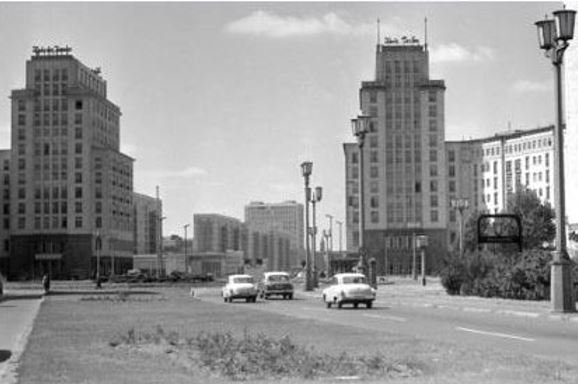
Blick auf neu errichtete Häuser in der Stalinallee, Berlin-Friedrichshain, 1963

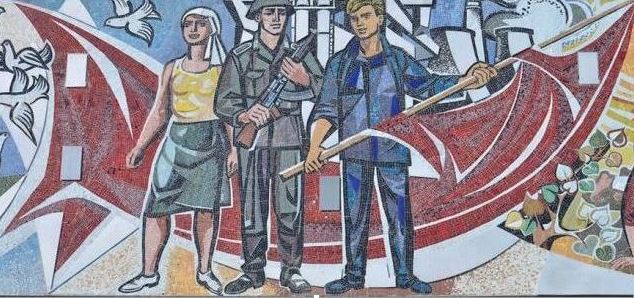
Wandfries von Walter Womacka
Haus des Lehrers, Berlin-Mitte, 1965

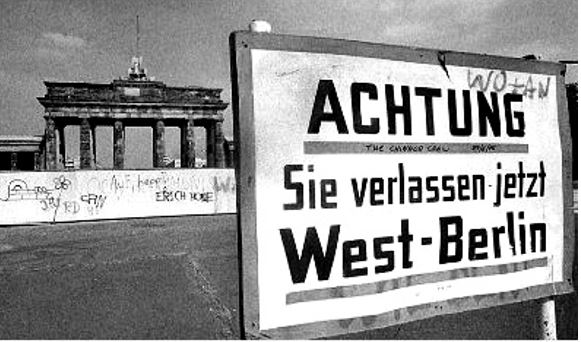
Auch in Ost-Berlin gab es Formen der Straßenkunst, allerdings waren die Künstler in ihrer Freiheit stark eingeschränkt und mussten sich streng an den verordneten sozialistischen Realismus halten, wie hier auf dem Wandfries von Walter Womacka aus den 1960er Jahren zu sehen. Auch in Ost-Berlin wurden politische Parolen an Häuser und Wände gemalt, die aber meist sofort von der Staatssicherheit entfernt wurden. In West-Berlin präsentiert sich die Berliner Mauer zunächst nur als riesige Leinwand, auf die ab den 1970er Jahren politische Parolen, Wandbilder und später Graffiti gemalt und gesprüht werden.


Die teilende und tödliche Berliner-Mauer, 1961-1989

Wandfries von Walter Womacka
Haus des Lehrers, Berlin-Mitte, 1965

In ihren Anfängen fand die Streetart viele Befürworter. Der Zweite Weltkrieg hatte in Berlin viele Spuren in Form von Brandmauern und Bombenblindgängern hinterlassen, die durch die Wandmalereien verdeckt werden konnten. Die Politik förderte die Streetart-Projekte in West-Berlin mit Gestaltungsprogrammen und Wettbewerben wie Kunst am Bau. Zahlreiche Künstler brachten unterschiedliche Stile und Techniken mit, das Ziel war ein aktiver Eingriff in das Stadtbild.

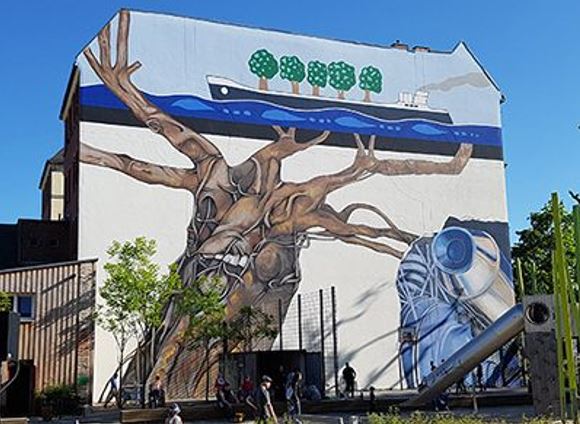
Ben Wagin, “Weltbaum”
Berlin-Tiergarten, 1977/2018

Alles begann mit einem stöhnenden Baum, der von heftigen Autoabgasen umgeben war. Das Umweltwerk “Weltbaum” von Ben Wagin war das erste große Wandbild, das 1977 im Westteil Berlins entstand. Aufgrund von Bauarbeiten ist es nicht mehr an seinem ursprünglichen Platz zu sehen. Deshalb wurde es im Mai 2018 an einem geeigneten Gebäude in der Lehrter Str. neu gemalt und rekonstruiert.

Gert Neuhaus, “Zipper”
Berlin-Charlottenburg, 1979

Marilyn Green, Rainer Warzecha und Christoph Böhm
“Modell Deutschland”, Berlin-Kreuzberg, 1981

Politische Parolen, die auf Hauswände gemalt oder gesprüht werden, sind seit jeher Teil politischer Bewegungen, nicht erst seit der westdeutschen Hausbesetzerbewegung der 1970er und 1980er Jahre, die sich dieses Ausdrucksmittels intensiv bedient. Besonders stark und aktiv war die Hausbesetzerbewegung in West-Berlin, wo viele Häuser ungenutzt, leer oder in sehr schlechtem Zustand waren.

Hausruine am Winterfeldplatz
Berlin-Schöneberg, 1981

Wandgemälde auf einem besetzten Haus
KuKuck, Berlin-Kreuzberg, 1982

Die Werke, die in den 1970er Jahren in West-Berlin und später in der Hausbesetzerbewegung der 1980er Jahre entstanden, hatten oft eine politische Botschaft – wie der “Weltbaum” von Ben Wagin oder das inzwischen verschwundene Wandbild “Modell Deutschland” von Marilyn Green, Rainer Warzecha und Christoph Böhm. Auch die Illusionsmalerei war sehr beliebt. Ein Beispiel ist der noch heute existierende Giebel “Zipper” des Künstlers Gert Neuhaus.

Sigurd Wendland, “Potsdamer Str. 1945”, 2. Weltkriegsbunker, Berlin-Schöneberg, 1983

Harald Juch, “Chernobyl Disaster”
Berlin-Schöneberg, 1986

Blick auf den Kurfürstendamm
Berlin-Charlottenburg, 1987

Gert Neuhaus, “Phönix”
Berlin-Charlottenburg, 1989

Illegale Untergrundkunst existierte im gegenseitigen Einvernehmen neben Auftragsarbeiten, die meist von Wohnungsbaugesellschaften vergeben wurden. Manchmal überschnitten sich die Arbeiten auch, oft verschwanden sie wieder. Mit den großen politischen Umbrüchen ab Ende 1989 hat sich in Berlin auch in Bezug auf die urbane Kunst viel verändert, aber das ist bis heute so geblieben!

++++×+××××××××××+++×××××××××××××××

Best of Synthwave and Retroelectro, BadJays, 2016