THE WEIRD STORY OF THE FIRST GERMAN MOSQUE


Completely by chance I stumbled on the above 100 year old postcard image, which made me curious to know what it was all about, because a mosque somewhere in the vastness of the Mark Brandenburg I had never seen before. The postcard shows parts of the so-called Half Moon Camp in Wünsdorf including the camp’s own mosque.

The Half Moon Camp was built at the beginning of WW I in what was then Wünsdorf near Zossen as a camp for about 30,000 Muslim Arabs, Africans and Indians (but also Hindus and Sikhs) prisoners of war who were sent from the colonies as part of the British and French armies in 1914/1915 to fight in the merciless and man-eating trench and position warfare on the Somme and elsewhere.

Former site of the camp/mosque in Wünsdorf

In addition to the inmates of these two colonial armies, however, Muslim members of the Imperial Russian Army were also interned there. In the Crescent Camp itself, active attempts were now being made to persuade the prisoners of war detained there to switch sides as part of a Muslim ‘holy war’ against the two colonial powers, England and France, “in order to wage a kind of guerrilla warfare with local rulers and tribal lords, thereby tying up as many English and French troops as possible, who would then be missing from the European battlefield.” (1)

Recreation and food distribution in the Wünsdorf Crescent Camp around 1915

At the request of the Mufti of Constantinople, therefore, the wooden mosque pictured above was also built in the camp in 1915 (the first mosque ever built in Germany). This was “supplemented by visits and speeches, especially by Turkish, Tatar and Arab politicians and journalists, who sought to influence the prisoners not only in the sense of German-Ottoman brotherhood in arms and pan-Islamic solidarity.” (2) In addition to the daily briefings, there were also propagandistic camp newspapers in several languages; besides, special attention was paid to the strict observance of Muslim rules (e.g. fasting during Ramadan). However, there is no doubt as to how many camp inmates actually changed sides.

From a historical point of view, this strategy – pushed on the German side by the orientalist and diplomat Max von Oppenheim – is in any case nothing new. “Already the legendary Muslim ruler Saladin had repeatedly entered into alliances with the Franks against rival Muslims or Christians. … The Ottoman Empire had called for holy war in most, not to say all, of the military conflicts in its history.” (3) As a relic of this dubious past in Brandenburg, however, only the Indian cemetery of Zehrensdorf can be found today; nothing remains of the Half Moon Camp itself except the street name Moscheestr. in today’s community of Waldstadt (district of Zossen), a road leading to the former site of the Half Moon Camp mosque, but today a postmodern wasteland.

Indian relief on the cemetery in Zehrensdorf

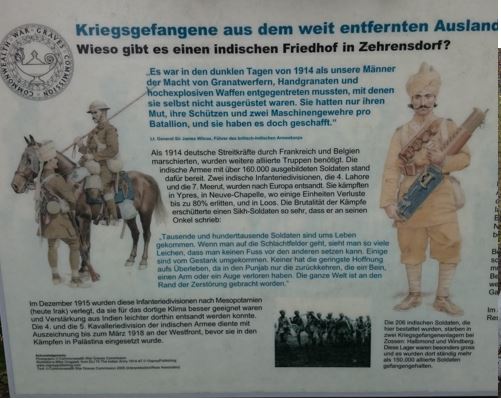
Finally, located outside of Zossen about 500 meters off the L74 highway in a wooded area is the cemetery of honor for the 206 Indian soldiers of the Half Moon Camp who died in captivity. This final resting place was rededicated in 2005 as the Zehrensdorf Indian Cemetery in the deserted area of the former Zehrensdorf. Also on the grounds is a memorial and grave marker for the Muslim Tatars from Russia who died here on site.

A bronze memorial plaque at the entrance to the Indian cemetery reads in German and English that the Indian soldiers buried here fell for their country, and that is a bit cynical, because no German, Austrian or Ottoman soldier ever set foot on Indian soil during World War I or before or after to cause trouble there or even to occupy this faraway land. And who would want to die far from home in a completely senseless war? And so it is not surprising that in the former colonies of Morocco, Algeria, Tunisia, India, Pakistan and Singapore there was great resistance and also real uprisings against the war effort in faraway Europe, which was, however, ruthlessly suppressed everywhere by the colonial powers. And without these colonial troops (especially those from India) the course of the war would have been different.
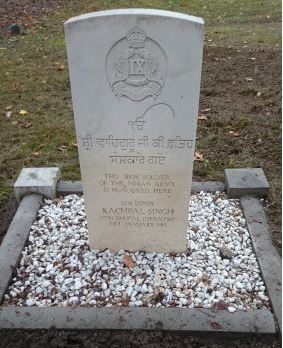
Indian single grave at the cemetery in Zehrensdorf

The cemetery is very well maintained and it is good that there are these places of remembrance, where a critical examination of history can take place. During my visit, gardeners were busy removing the traces of autumn, I also noticed many new individual gravestones, but it is a rather remote and somehow forgotten place in the vastness of the Mark Brandenburg hemmed in by the typical Mark Brandenburg pines and forests. So how often do visitors really get stranded here? I saw only a few traces of visitors, withered remains of memorial wreaths that are probably laid there once a year. The slightly foggy and hazy weather and the cold and damp wind of Autumn exactly matched these irritating alien impressions of another era.


(1)  Loth/Hanisch (Hrsg.), Erster Weltkrieg und Dschihad, München 2014, S. 15
(2)  Gerhard Höpp, Muslime in der Mark, Berlin 1997, S. 73
(3)  Stefan M. Kreutzer, Dschihad für den deutschen Kaiser, Graz 2012, S. 61
 

URBAN MAZE AND VISION


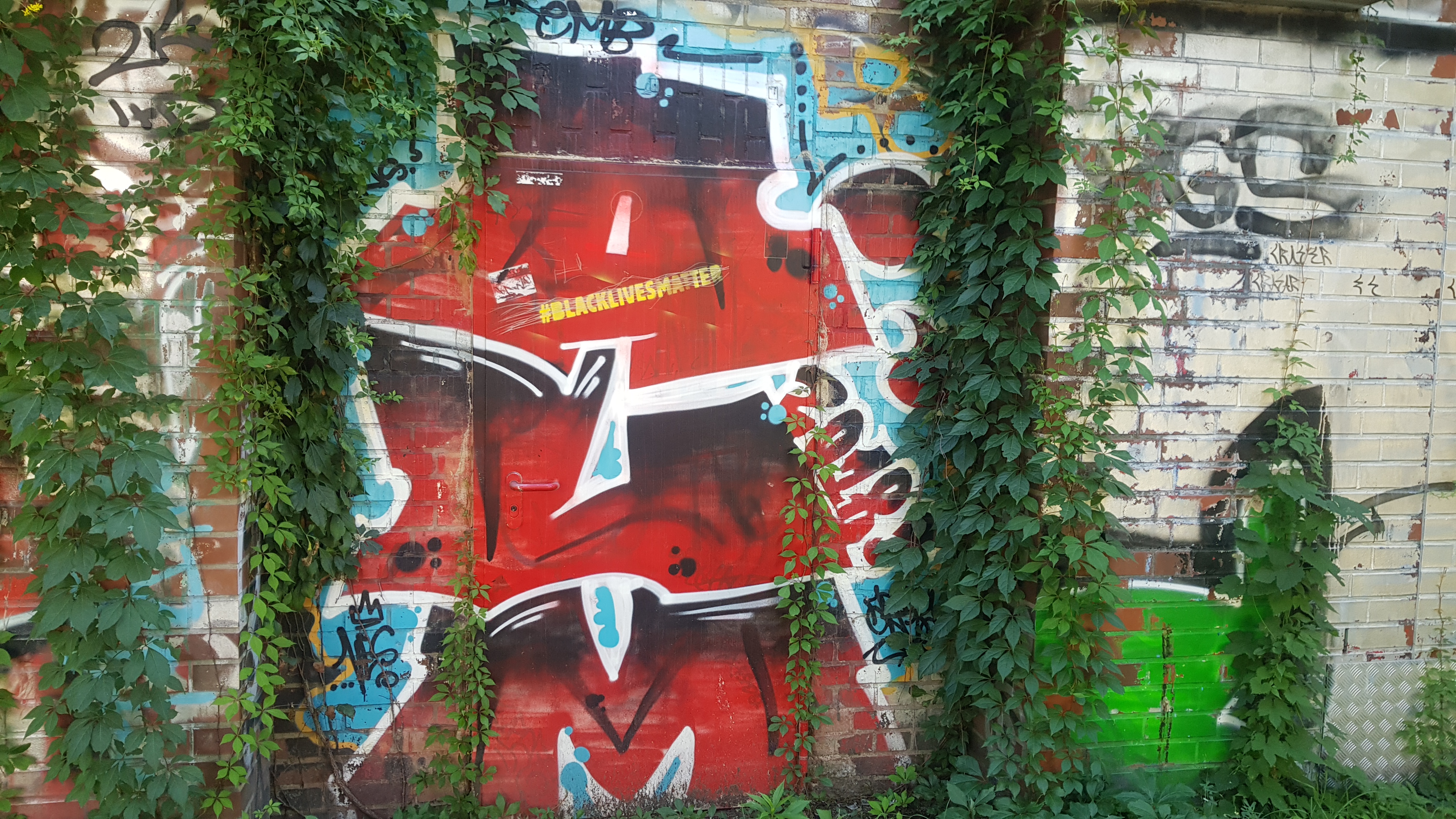
Sometimes reality and magic build a fruitful symbiosis in daily life – unusual situations arising from random collisions of open minds. These more time-limited incidents can tell us true stories – tangible modern mysteries of past and present times. Such sudden surprises loose their real attraction when looking for a sense or necessity in each and everything. Just following the flow of happenings, more often leads to fascinating objects when we simply stumble over the diverse silhouetted fans of reality. These visualized dreams are hiding at unexpected places or may also be not visible by first glance, visionary connections such as these here picked up at diverse locations in the city of Berlin.
The movement will not stop at a street-corner, let’s follow it and search the next challenge in the municipal maze.


ENCHANTED FOREST

In our neighbourhood at home one of our favourite trails for hiking leads through Briese Valley / Briesetal near the Northern gates of Berlin. The Briese is a small, not very long river flowing mostly in a glacial groover. Here you may find a wild alder swamp forest, beaver dams and marshland in quite original condition. During our recent visit nature has rested still in winter mode but at least some green to be admired on the watersurface.

The nicest part of this trail starts at the village of Briese in the direction of Zühlsdorf over a distance of around 6 km. There it is possible to make a rest at a nice old forester’s lodge in the woods where you get small snacks (such as homemade deer sausage) and drinks during the weekend all year round and then go back on the other riverside with different views, a nice roundtrip of approx. 12 km.


SECRETS OF A GARDEN

for Ingrid


Today, 80 years after the end of the bloody Second World War and the final liberation of Germany from disgusting and miserable fascism, I would like to write about a peaceful place with a special history. The fact that peace has prevailed in the heart of Europe for so long is, historically speaking, not really a self-evident matter. And unfortunately, one war often leads to another. This has been the case in Europe for centuries, with hundreds of wars in the last 500 years alone. And the current war in Ukraine is just as much a part of this, because it can also be seen as a direct successor to the Second World War, at least the Russian war narrative provides daily proof of this with the abstruse claim that the only thing being fought in Ukraine is against Nazis, while the current Ukrainian President Selensky is a Jew!

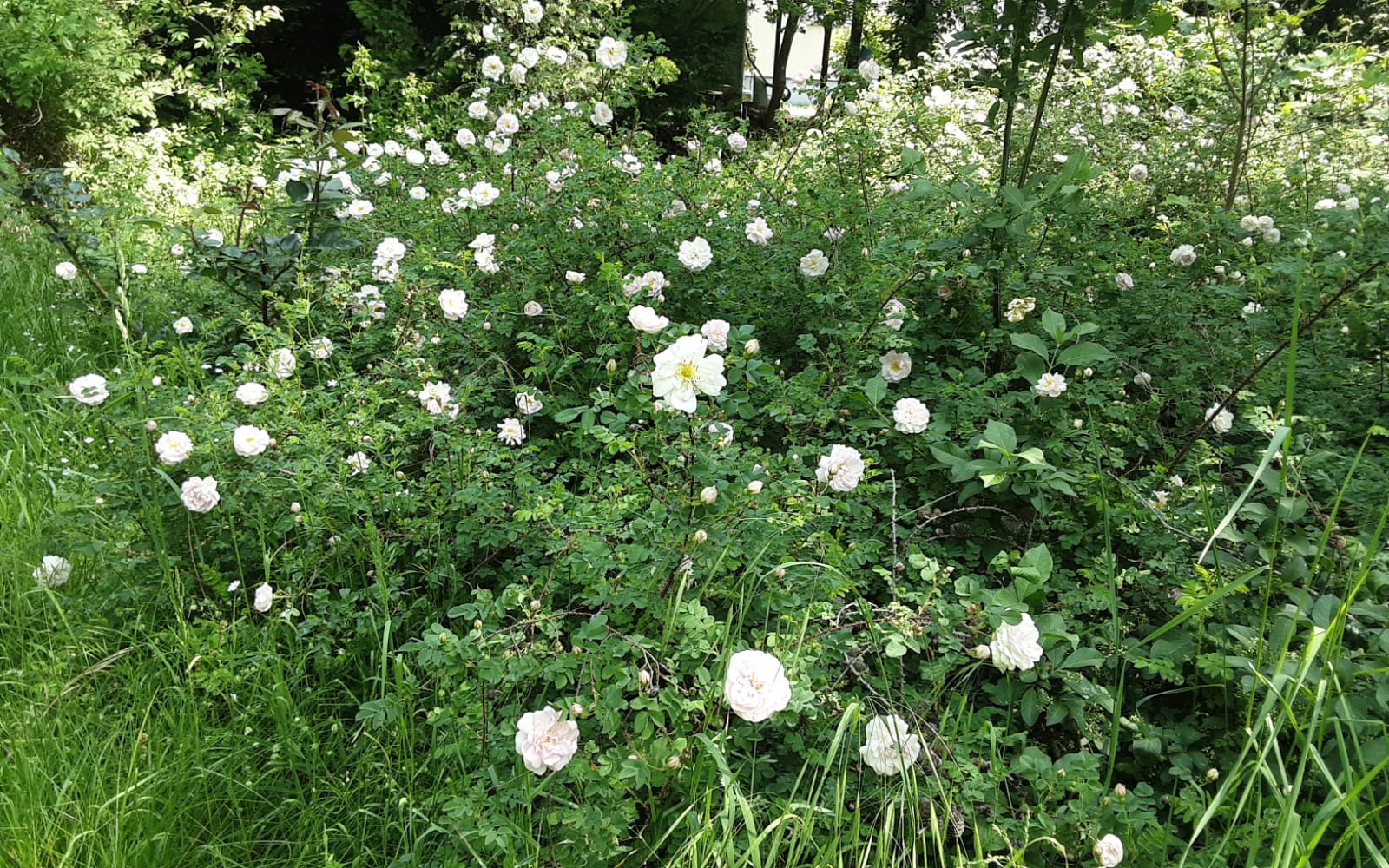
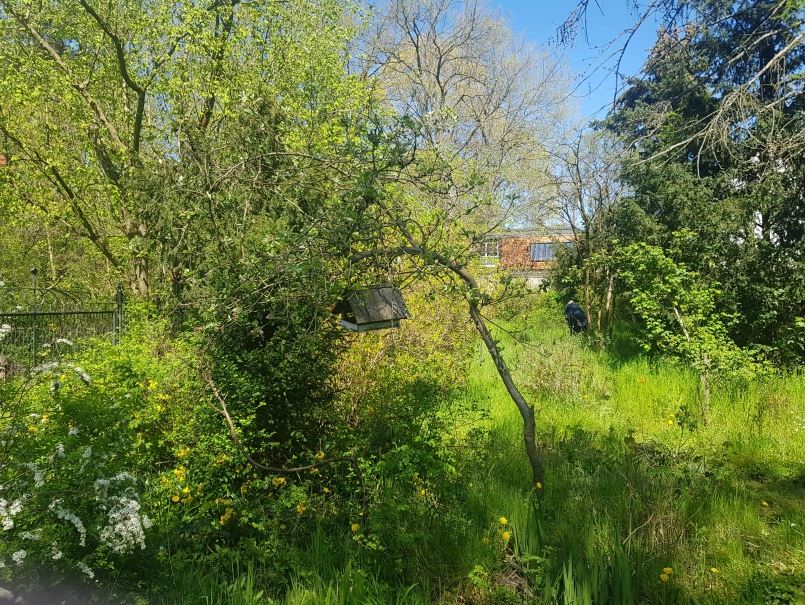
But here in the garden and in the whole country there is peace today, what happiness! But it’s not just a biotope like this that needs looking after. And this peaceful green idyll has been maintained for decades by a still very sprightly enthusiast called Ingrid, who is now 87 years old. However, she can no longer do as much as she used to, so things are getting wilder and more pristine here in her beloved garden. A storm knocked down birch trees in the garden many years ago, but there is nothing left to see of the old trunks and branches, as they have since been completely overgrown by all kinds of moss, grasses and plants, so that they have become one with the earth from which they once grew. So everything here has taken its usual natural course to the delight of insects and birds, who are offered a beautiful retreat with all kinds of hiding places in the very eastern part of Berlin.

In the 19th century, this was still a completely rural area, and for a long time this land also served as a gypsy camp far from the gates of aspiring Berlin. Towards the end of the 19th century, a senior forestry official of the Prussian government acquired this area and built a country house here, where he also carried out botanical experiments and planted rare trees on a trial basis, for example. This country house for the summer has survived all the historical turmoil and still stands here today. Probably for financial reasons, the forestry official then sold the property and house to a Jewish family in the early 1920s, who found a new home here for a while.

Hitler’s seizure of power in Germany in 1933 and the associated inhuman anti-Semitic rage of the Nazis in the country forced the Jewish family into exile in the USA and England. Fortunately, they did this very quickly in 1933, when it was still relatively easy for Jews to simply turn their backs on Germany. Ingrid’s parents, who were friends with the Jewish family, now moved into the old country house as tenants and also took care of all the formalities associated with the house. They acquired part of the property which today forms this fascinating garden. The country house itself was confiscated by the Nazis at some point and sold to a German master baker.

During the GDR era, this was then managed as a special asset and was only under communal administration (in the absence of the Jewish owners). In 1958, the Jewish family once again visited Germany, their old no-longer-home and also their friends here in the old country house. There was later still some correspondence across the ocean, which eventually dried up, but Ingrid’s family continued to live here on a rental basis until the early 1990s. Then, after the end of the GDR, the house was transferred back to the descendants of the Jewish family from the USA, who also came back to Berlin to the house of their ancestors for all the formalities. Thanks to legal documents and papers from the Weimar period that were kept here by Ingrid’s family, the restitution was relatively easy. However, the garden had been legally sold in 1933 and therefore remained in the possession of Ingrid’s family.

Here in the garden you can still find all kinds of relics of times long past, which are slowly disappearing into a new jungle. Today, there is a stumbling block on the sidewalk in front of the old country house, which commemorates the former Jewish residents of the house who were forced to seek their fortune in the big wide world far away.


POSTCARDS FROM EAST-BERLIN / GDR


The above colorant picture shows a detail of the wall freeze at House of the Teacher near Alexanderplatz, Berlin-Mitte. It was realized by GDR artist Walter Womacka in 1965 and reflects the modern spirit of those days quite well in the style of Socialist Realism. However, similar imagery like here above did exist in the West as well in the 1960s –  mostly on rather large houses.

Parade in East-Berlin / 30th anniversary of the founding of the GDR
photo made on 7 October 1979 by Wolfgang Kluge, CC-BY-SA 3.0

In the early 1980s I already lived in West-Berlin and joined the international mail-art network where I was active till 1991. Here artists from around the world practized mutual exchange and collaborations via the good old postal services, a kind of slow blogging existing till today.

Especially for people living in the former communist countries of East-Europe mail-art was a nice option for keeping in touch with the rest of the world. So here I will show you some postcards and/or other correspondence received by me from East-Berlin and other parts of former GDR in the 1980s.

I know nothing but art / Robert Rehfeldt, East-Berlin

A printed message / Joseph W. Huber, East-Berlin

I was also sometimes, not very often, in East-Berlin, so I did meet Robert Rehfeldt and Joseph W. Huber also in real life and personally, both are already deceased. 

Jungle of Art / Collaborative, postal and collective collage

I am writing and posting all this as part of a global process which means fundamental creativity in itself.

Authorities misdirect / Roland Beier, Neubrandenburg

Abstraction / Jörg Sonntag, Dresden

Exit-Sticker / Wolfgang Schneider & Thomas Westermann, Magdeburg

Looking at the diverse messages nearly 40 years later is quite strange, I can mostly not find anything GDR typical, may be in the next one.

Decadent mail (both sides) / Birger Jesch, Dresden

Creativity and/or art and/or anti-art (whatever you prefer and like) can not be controlled completely or transmuted to sheer propaganda it will  always survive and blossom  at least in our minds from where new bridges can be built even thru very thick walls and right out of gruesome dungeons. 


Serigraphy / Uwe Dressler, Cottbus

ON THE BRINK OF FASCISM


Donald Trump by Bernd Löbach-Hinweiser


Donald Trump’s first two months as the new US president in 2025 have been characterised by the motto ‘shock and awe’. The aim is to spread terror and awe, with new radical advances being presented daily or sometimes hourly at an incredibly rapid pace. Every day, new details come to light about how the government is corruptly and unscrupulously pushing ahead with the right-wing authoritarian reorganisation of the state. Trump doesn’t seem to care about rules, treaties or previous alliances. So Wladimir Putin is very happy about the US turning into a rogue state that wants to annex Canada, Greenland and the Gaza Strip in a disgusting and imperialist manner while this US administration is even doing all the dirty work for the Russian new Tsar in the direction of Ukraine. Who is going to stop all this?


The new US flag by Ben Chilton


VAGABOND ESCAPE

In the white waters a seemingly paradoxical option emerges all of a sudden from the depths of mind which commands to insist vividly on the rule of vague exceptions and while following this intuitive desire to drift away on the waves of a final eternal ambition. Only a little bit later in the sphere of phantastic probabilities, the restless vagabond approaches subsequently the all penetrating net with speed of light where cause and effect of intentions are mututally eliminating and reversing themselves in a material torrent of final escape. Then it is the right time to start simply another game on such playing ground as a haunting gamechanger in green. When boosting to the end point of this windy confused route of these endless imaginary grasslands, to begin the eternal play another time again and again …

Ummet Ozcan – Kalimba -, 2023


COOL PLEASURES

I like the winter time very much and when the weather is dry, sunny and also quite cold then, suddenly a complete clarity can spread in our minds. So the month of January – which is also my birth month – is always something special for me in the annual cycle, when the old year is still present after a new year has already begun. This is possibly why the ancient Romans dedicated this month to their ancient god Janus, better known as the god with two faces, who symbolised both beginnings and endings for them – the spirit of entrances and exits.

Icy mountain station on the Fichtelberg (1,215 m) near the German-Czech border

January is usually also the coldest month in the northern hemisphere and begins nine or ten days after the winter solstice, which here means the shortest day of the year and a very long night – a day that is also very important for past cultures and earlier civilisations. In the ancient Celtic cycle of the year, the so-called ‘Raunächte’ begin soon after at midnight on 24 December and last until sunrise on 6 January. For our ancestors, these were truly holy nights, a time spent with family and festivities, in other words, what today is more profanely called the Christmas season.

That’s me and my fast luge in action

Of course, this must also be a good time to really enjoy winter in the mountains, when snow crystals in thick layers cover trees and bushes, hills and meadows, houses and paths in sometimes mysterious and strange ways, inviting you to move on to the distant horizon.

Endless forest path in snowy disguise

And after such a walk through the white-painted woods, it’s time to dive into the real soundtrack of winter: The Walrus Hunt by The Residents  is one of my favourite songs. And now welcome to the real north, the home of the Inuit.


TIME FOR A SIESTA

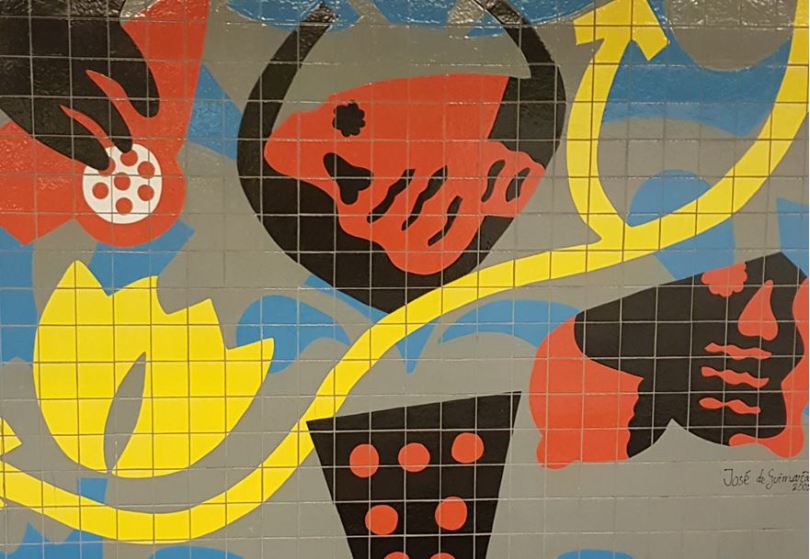
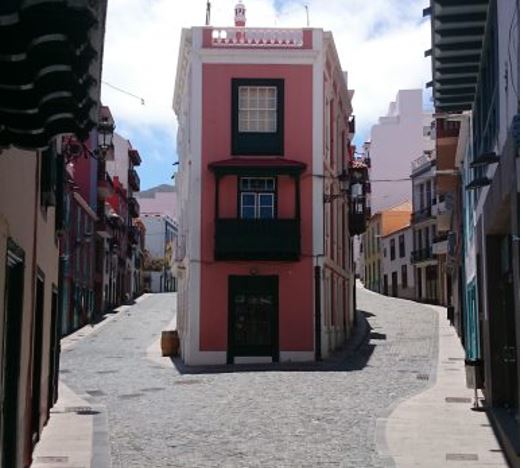
The vast poetry of empty streets and colorful houses leaves a lot of space for imagination and dreaming following irrevocably very old ambitions. At noon the sun now moves slowly around the very next corner where the shadows shrink to minimalistic images of black, white, blue and red. All is slowing down irresistible, and time stands still for a while. A real moment of peace in a world full of archaic, violent and stupid conflicts all over our nice blue planet! 
Wishing you a very nice season and a happy new year 2024 🎃💥🥳


*************************************************************************