
Postcard with view on the castle of Cesky Krumlov, 1924
Hardly any other place inspired Egon Schiele as much as Krumlov, one of the most beautiful Renaissance towns in Europe and a first-class architectural jewel. Its beauty and location in the heart of the Southern Bohemian cultural landscape have always made this town a centre of attraction for painters and writers.

Old houses in one of the many winding alleys

Greened facade and entrance door in the centre
The winding, confusing ensemble of houses on the Vltava River looks like something out of a Grimm’s fairy tale. A magnificent castle towers over the old town centre with its humpbacked alleyways, squares, rippling fountains and churches. The Old Town is picturesquely surrounded by the Vltava river, which meanders wildly here in a rather primordial manner and attitude – a gesticulating nature at its finest.

Former Austrian Emperor hanging over the bar at Restaurant Schwejk
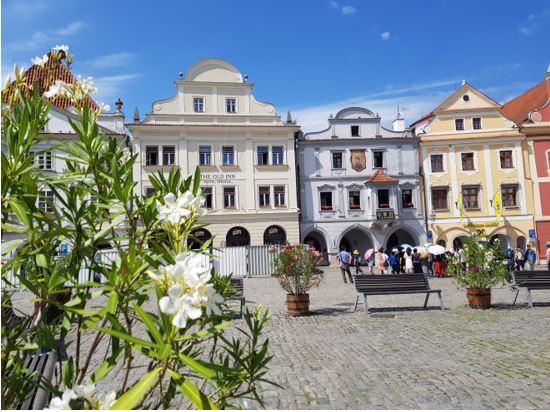
The finely restored market-place with charming flowers
We visited this enchanting place for the first time in the 1990s, when it still had more socialistic charm with many unrenovated houses. On the other hand, it was very tranquil and authentic, which is no longer the case today. In the high season, crowds of tourists push their way through the city, which is so popular with Chinese travellers in particular that a copy has been built in China in the city of Dongguan. A visit in the low season is therefore advisable.

Fashion outlook in a shop’s window

The lovely studio house of the Austrian painter Egon Schiele
The Austrian painter Egon Schiele was also enthusiastic about Krumlov, the birthplace and hometown of his mother, throughout his life; he had known the small town since his childhood from visits to relatives and also spent his holidays in Krumlov during his time at the academy. In May 1911, Schiele and his partner Wally Neuzil – a former model for Gustav Klimt – moved to Krumlov; they enthusiastically moved into the garden house of the art-loving merchant Max Tschunko, where Schiele was finally able to work outdoors. However, the idyllic hustle and bustle in the artist’s hermitage soon came to an end. The couple’s wild marriage and the fact that Schiele modelled for very young girls outraged the townspeople so much that he was forced to leave Krumlov again in August 1911: ‘I don’t want to think about Krumlov, I love the town so much, but the people don’t know what they’re doing.’

Egon Schiele, Krumau (Krumlov), oil on canvas, 1915
Despite the really too many tourists today, you still find very quiet and inspiring places in the city or optionally just make a surprising rafting tour on Vitava river around the beautiful and impressive city. This is definitely a good way to round off a visit.







 SUBURBAN TRACKER
You must be logged in to post a comment.