In these hectic and in many ways unsettling times, Berlin’s Museum Island is currently an oasis of calm and relaxation at the Bode Museum which is actually hosting a project named “The Healing Museum” until further notice. This project combines mindfulness, medical research and art history; it is the result of a collaboration between the Experimental and Clinical Research Centre of Charité and the Bode Museum
Medical studies show that visiting art museums reduces stress and anxiety and improves overall mental health. Looking at artworks and walking through museum spaces can be exhilarating because it helps us develop the skill of mindfulness. Now the Bode Museums offers you the opportunity to learn practical mindfulness exercises or to deepen your existing skills in this field.
A specially designed museum room is available for this purpose, which shows the interwoven meditation traditions of Buddhism, Islam, Christianity and Stoicism and traces their influence on the new mindfulness movement of the 21st century. A selection of inspiring meditations can be accessed free of charge via the audio guide, by mobile phone or via the website. A bench and cushions are available.
Address: Bode Museum, Am Kupfergraben, 10117 Berlin, right on the museum island.
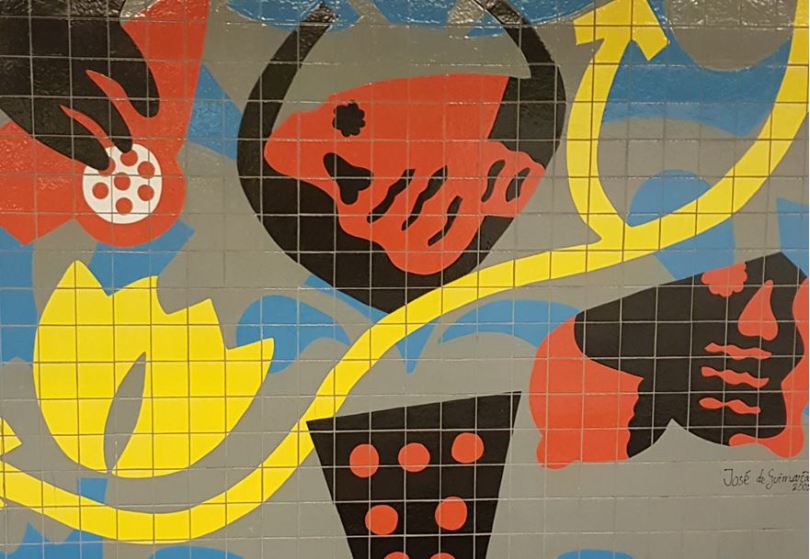
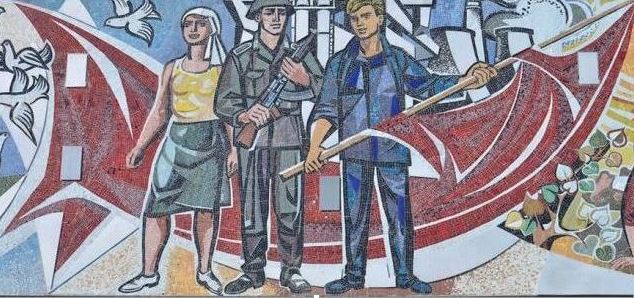
The above colorant picture shows a detail of the wall freeze at House of the Teacher near Alexanderplatz, Berlin-Mitte. It was realized by GDR artist Walter Womacka in 1965 and reflects the modern spirit of those days quite well in the style of Socialist Realism. However, similar imagery like here above did exist in the West as well in the 1960s – mostly on rather large houses.
Parade in East-Berlin / 30th anniversary of the founding of the GDR
photo made on 7 October 1979 by Wolfgang Kluge, CC-BY-SA 3.0
In the early 1980s I already lived in West-Berlin and joined the international mail-art network where I was active till 1991. Here artists from around the world practized mutual exchange and collaborations via the good old postal services, a kind of slow blogging existing till today.
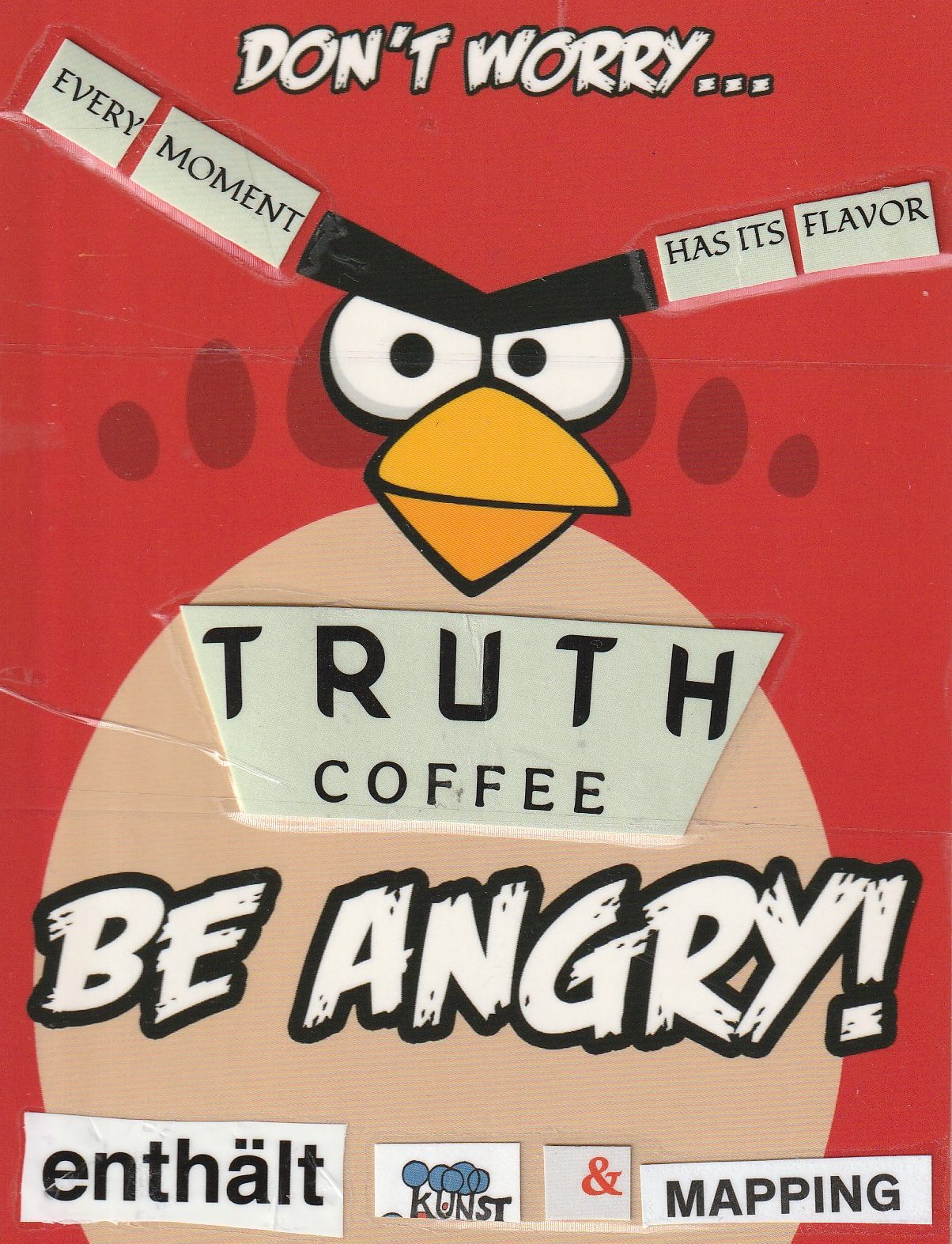
Especially for people living in the former communist countries of East-Europe mail-art was a nice option for keeping in touch with the rest of the world. So here I will show you some postcards and/or other correspondence received by me from East-Berlin and other parts of former GDR in the 1980s.
I know nothing but art / Robert Rehfeldt, East-Berlin
A printed message / Joseph W. Huber, East-Berlin
I was also sometimes, not very often, in East-Berlin, so I did meet Robert Rehfeldt and Joseph W. Huber also in real life and personally, both are already deceased.
Jungle of Art / Collaborative, postal and collective collage
I am writing and posting all this as part of a global process which means fundamental creativity in itself.
Authorities misdirect / Roland Beier, Neubrandenburg
Abstraction / Jörg Sonntag, Dresden
Exit-Sticker / Wolfgang Schneider & Thomas Westermann, Magdeburg
Looking at the diverse messages nearly 40 years later is quite strange, I can mostly not find anything GDR typical, may be in the next one.
Decadent mail (both sides) / Birger Jesch, Dresden
Creativity and/or art and/or anti-art (whatever you prefer and like) can not be controlled completely or transmuted to sheer propaganda it will always survive and blossom at least in our minds from where new bridges can be built even thru very thick walls and right out of gruesome dungeons.
Donald Trump’s first two months as the new US president in 2025 have been characterised by the motto ‘shock and awe’. The aim is to spread terror and awe, with new radical advances being presented daily or sometimes hourly at an incredibly rapid pace. Every day, new details come to light about how the government is corruptly and unscrupulously pushing ahead with the right-wing authoritarian reorganisation of the state. Trump doesn’t seem to care about rules, treaties or previous alliances. So Wladimir Putin is very happy about the US turning into a rogue state that wants to annex Canada, Greenland and the Gaza Strip in a disgusting and imperialist manner while this US administration is even doing all the dirty work for the Russian new Tsar in the direction of Ukraine. Who is going to stop all this?
The state of poetry
does not hold a secret to any of you.
It does not sell and has scattered,
after having been much prized.
So have pity on the poets,
for they are like the dead among the living
because of their impoverishment.
by Rifa’a Rafi’al-Tahtawi, 19th century, Egyptian imam & author
In the white waters a seemingly paradoxical option emerges all of a sudden from the depths of mind which commands to insist vividly on the rule of vague exceptions and while following this intuitive desire to drift away on the waves of a final eternal ambition. Only a little bit later in the sphere of phantastic probabilities, the restless vagabond approaches subsequently the all penetrating net with speed of light where cause and effect of intentions are mututally eliminating and reversing themselves in a material torrent of final escape. Then it is the right time to start simply another game on such playing ground as a haunting gamechanger in green. When boosting to the end point of this windy confused route of these endless imaginary grasslands, to begin the eternal play another time again and again …
Vaterländer und Mutterbänder.
Kampf ist ein grosser Markt. Überall metabol – vidit et dixit. Verschwitzt die Haare, voll Schmutz die Füsse.
Sphinkter erwachen.
Die Walküren machen einen auf Brezel.
Sorgenfrei im Kriegerparadies.
Keine Sinnkrisen, keine Herzattacken, keine Masken,
viel Hurrah – ‘s Handy immer voll dabei.
Das leckere Hojotohöhchen!
Es gibt Met, Guiness und Kachelfleisch.
Fricka mit doppelt geflochtenem Dutt,
Odin mit Undercut und an der Grenze zum Porösen.
Die Verwertung des Knochens, Collage, Paula J. Jesgarz, 1989
Kampfjungfrau Svipul füttert Geri und Freki,
die beiden betonimmunen Wölfe von Odin –
stark protoindoeuropäisch.
Alles konkrete Weltformel:
Im Kampf draufgehen oder jede Nacht einen draufmachen.
Später Erbrechen als Welle und Partikel –
eine frühe Weltformel, paleo und mystisch,
schon so ein bischen Quantengravitation.
Alles unter der großen Esche.
Heute ist das lockerer:
Mit dem Sportboot zum Girokonto fahren
und dann bei Schampus und frischen Brötchen
Latex auf die Freundin ziehen.
Alles demokratisch und ohne Schwert.
Walhalla war mal, Dada bleibt.
So wie Vaterländer und Mutterbänder.
Stunde Null, Kassel, 2023
#############################################
Email-Kontakt: w.guenther.esperanto@web.de
Veröffentlicht unter Creative Common Licence No. CC BY-NC-ND 4.0
“The photocopied everyday life of Albrecht/d.” was the title of an article in the Saarbrücker Zeitung of 1 September 1989. The occasion was an exhibition of Albrecht/d.’s work at “Galerie im Zwinger” in St. Wendel. This headline is a pointed approach to the work of the artist, who was born in Nordhausen in 1944 and moved to the Federal Republic in 1958. After school, he did a bank apprenticeship in Stuttgart.
Postcard by Albrecht/d. with self-portrait in late 1989 – on the card a sticker saying: “The divergence, art market-art history potentiates to esotericism in the 1990s”
In a text about the role of photocopying in his work, he told how he discovered his fascination with photocopiers as a bank apprentice. “Between 1962 and 1966 i worked at a bank and saw the use of the photocopy in everyday office life. for me, the blurriness of these first photocopiers in contrast to the brilliance of the black and white photos was really fascinating. […] After 1965 i began to achieve alienation effects by photocopying collages and it was not until 1969 that klaus staeck was the first to accept the aesthetics of photocopying and to accept photocopies instead of photos of actions for printing in the catalogue <<intermedia heidelberg 1969>>. in 1968 i began to blow up passport-size originals to din a 4 on an automatic copying machine (zinkkopie) and to process them into collages or graphics.” (Albrecht/d. on photocopy in his work)
Working with the machines, Albrecht/d. quickly realised that copiers could be manipulated and thus integrated into an artistic process. They made it possible to produce mass printed matter easily, quickly and relatively cheaply when print quality was of secondary importance, e.g. for leaflets. In 1968, Albrecht/d. founded his own small publishing house, reflection press.
While Albrecht/d. had initially focused on Dadaism, from 1965 onwards he also became involved with Fluxus. He worked closely with other Fluxus artists, but ultimately remained the only representative of the movement in Stuttgart with his Fluxus actions in the Stuttgart-Zuffenhausen youth centre. Like many of his companions at the time, Albrecht/d. wanted to break up the elitist in art. Joseph Beuys had formulated the succinct motto “Every man an artist”. Albrecht/d.’s art / anti-art followed this principle. As an art teacher, it was his job to bring art closer to pupils. As an artist, he saw this as a mission.
Advertisement for a Fluxus show, George Maciunas, 1962
For the 1973 symposium “Art in Political Struggle”, the Kunstverein Hannover asked the participating artists Albrecht/d., Joseph Beuys, KP Brehmer, Hans Haacke, Dieter Hacker, Siegfried Neuenhausen, Klaus Staeck and Wolf Vostell five questions, the answers to which were published in the symposium documentation. One question was: What do you want to achieve with your artistic work? How do you communicate this work? Who do you reach with it?
Albrecht/d. answered: „On the one hand, the aim of the work is to help politically active groups and so-called “lone warriors” in their work, the fight against injustice and oppression, by visualising problems and issues. . […] The question for the artist, who fights most successfully against oppression and injustice? is self-evident. The history of trade unions and the labour movement teaches that success is only achieved when the struggle of an individual is subordinated in favour of the struggle for rights in the group. Since the artist mostly sees himself as an individualist, there is the possibility of […] finding out about current problems and goals from different points of view.“
Albrecht/d., Artist’s Self Portrait, for “Vincent zu Liebe, van Gogh zu Ehren” exhibition at Kasseler Kunstverein, Kassel, Germany, 1990
The response not only contains the programmatic self-image of the autodidact Albrecht/d., who wanted to reach as many people as possible, regardless of their background, education or social status. It also provides a sense of the diversity of his artistic activity and his boundless enthusiasm for print media. And it also mentions his form of musical-artistic performance, also developed as early as the 1960s, which began as Fluxus, then became the concept of “endless music”, and was varied again and again under new names until the turn of the millennium.
Especially until the 1980s, these concepts were also designed in such a way that the audience could be involved, indeed could actively participate. For Albrecht/d., art education should also be the key to people. Every person should have access to art and have the opportunity to get involved themselves. He participated in countless, also international solidarity and benefit actions: for other artists, for the homeless, addiction counselling, migrants, cultural and environmental initiatives, etc.
Albrecht/d., Security of Nuclear Power is an Illusion, copygraphy, 1984
With the medium of photocopying and especially with the spread of colour photocopying, Albrecht/d. developed concepts for workshops which he then organised in cooperation with copy shops. Usually, several artists were present who demonstrated and explained the use of colour photocopies for alienations, colour transformations, for situational actions and other creative uses. Visitors could bring their own copy and experiment with it themselves. At the end of the 1980s, such experimental approaches were trend-setting.
Albrecht/d., For Norbert, copygraphy & mixed technique, 1985
Albrecht/d. always saw himself as a political artist, a separation of life and work did not exist for him. Violence in any form and its trivialisation by the media, leading to deadening, was one of his main themes. In his sometimes wall-sized compositions of interlinked individual collages – not unlike mind maps – he reflected the simultaneity of war, torture, oppression, expulsion, dehumanisation, environmental destruction, power, consumption, sex and pure triviality in a kaleidoscopic, dystopian rush of images that often brought his audience to the limit of overtaxing themselves, but purely analytically and associatively conveyed a very exact picture of our world – which, of course, many did not want to see in this way.
Albrecht/d., Car Picture, colored copygraphies & mixed technique with painted frame,1986/1989
Albrecht/d. did not limit himself to the intoxication of these visual worlds. A spiritual level always resonated in his work. From the 1960s onwards, he described himself as a pacifist Buddhist. Buddhism seemed to him to be the means to overcome the inhumanity of the world and its increasing destruction. There are countless references to Buddhism in his work, often only as small details. Albrecht/d. wanted to reach as many people as possible, he wanted to make us think, he had a message. And he wanted us to look closely.
Much more information can be found on the German website of Albrecht/d.:
A LONG-TERM PROJECT BY THIS KASSEL-BASED CONCEPTUAL ARTIST
Since 1991, Jürgen O. Olbrich has been checking public paper containers throughout Germany as part of his long-term project PaperPolice in order to save materials, recycle them transmutatively and then use them to supply several museums and private collections. In regular shows and also as part of performances, these artistic results are also distributed to the audience of such events in the form of PaperPolice packages.
From a recent invitation to a performance at Hannover in August 2023
Life is art enough is the artistic order keeper’s way of acting, experimenting with the possibilities offered by found objects and working with changing media. Communication and interaction are an essential part of PaperPolice’s strategic orientation. The found objects are thus saved from oblivion and form an archive of history, information and memory.
Example of collected waste stamped by the PaperPolice being also distributed by mail
Show & action at “Haus der Kunst”, Munich, 2022, photo: Hubert Kretschmer
From this archive, the rubbish then finds a way into other contexts, but the diverse materials are packaged into handy parcels beforehand, and visitors to public events are explicitly asked to take a parcel home with them, an offer that is gladly accepted by visitors everywhere (wherever they are).
Show & action at “Kasseler Kunstverein”, Kassel, Germany, 2005, photos: Günter Specht
“Artcell” – PaperPolice in action at Vienna, Austria, 2016, photo: Christine Baumann
In public and busy locations, the artist frequently finds material that is potentially dangerous or embarassing for the previous owner, such as bank account information or even personal pornography. So the complete project has not only environmental aspects by recycling but is also a huge fascinating information store of another kind.
Another example of collected waste stamped by the PaperPolice
It takes a certain creative obsession to pursue this fascinating waste project over decades and also to keep refining it. So it will be astonishing to see where the PaperPolice will appear next in Germany or elsewhere.
In den 1970er Jahren entwickelte sich die Graffiti-Szene, inspiriert von der aufkeimenden Hip-Hop-Bewegung, schließlich im New Yorker Untergrund. Innerhalb weniger Monate wurde sie zu einer gigantischen Welle, die auch auf Europa überschwappte. Die Punks und der Hip-Hop brachten die Streetart in ihre Hochburgen London und Amsterdam, von wo aus sie nach West-Berlin gelangten.
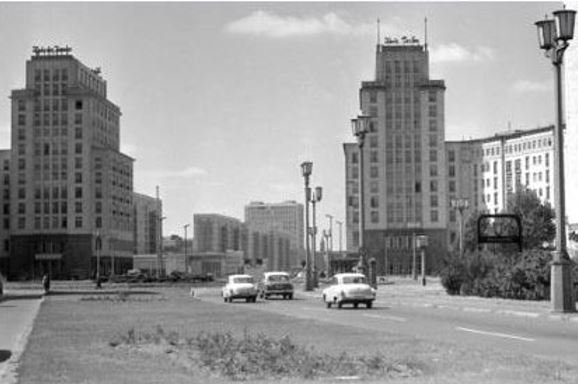
Blick auf neu errichtete Häuser in der Stalinallee, Berlin-Friedrichshain, 1963
Wandfries von Walter Womacka Haus des Lehrers, Berlin-Mitte, 1965
Auch in Ost-Berlin gab es Formen der Straßenkunst, allerdings waren die Künstler in ihrer Freiheit stark eingeschränkt und mussten sich streng an den verordneten sozialistischen Realismus halten, wie hier auf dem Wandfries von Walter Womacka aus den 1960er Jahren zu sehen. Auch in Ost-Berlin wurden politische Parolen an Häuser und Wände gemalt, die aber meist sofort von der Staatssicherheit entfernt wurden. In West-Berlin präsentiert sich die Berliner Mauer zunächst nur als riesige Leinwand, auf die ab den 1970er Jahren politische Parolen, Wandbilder und später Graffiti gemalt und gesprüht werden.
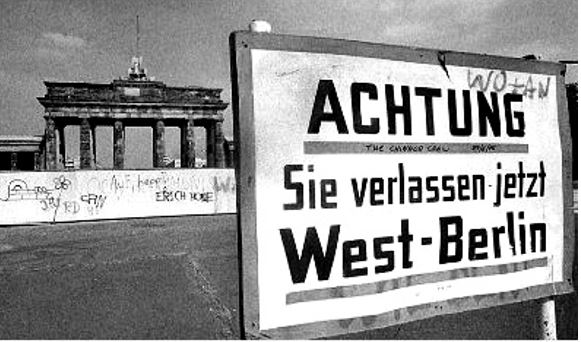
Die teilende und tödliche Berliner-Mauer, 1961-1989
Wandfries von Walter Womacka Haus des Lehrers, Berlin-Mitte, 1965
In ihren Anfängen fand die Streetart viele Befürworter. Der Zweite Weltkrieg hatte in Berlin viele Spuren in Form von Brandmauern und Bombenblindgängern hinterlassen, die durch die Wandmalereien verdeckt werden konnten. Die Politik förderte die Streetart-Projekte in West-Berlin mit Gestaltungsprogrammen und Wettbewerben wie Kunst am Bau. Zahlreiche Künstler brachten unterschiedliche Stile und Techniken mit, das Ziel war ein aktiver Eingriff in das Stadtbild.
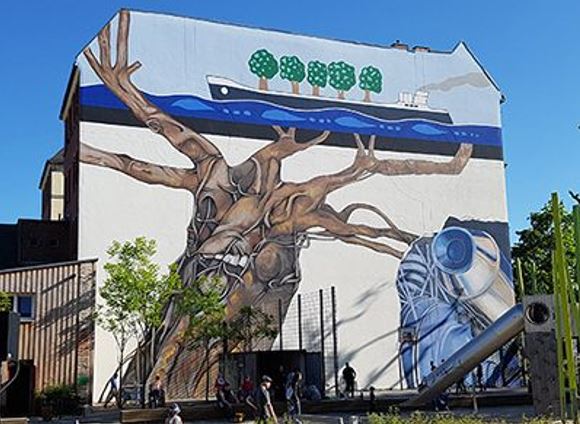
Ben Wagin, “Weltbaum” Berlin-Tiergarten, 1977/2018
Alles begann mit einem stöhnenden Baum, der von heftigen Autoabgasen umgeben war. Das Umweltwerk “Weltbaum” von Ben Wagin war das erste große Wandbild, das 1977 im Westteil Berlins entstand. Aufgrund von Bauarbeiten ist es nicht mehr an seinem ursprünglichen Platz zu sehen. Deshalb wurde es im Mai 2018 an einem geeigneten Gebäude in der Lehrter Str. neu gemalt und rekonstruiert.
Gert Neuhaus, “Zipper”
Berlin-Charlottenburg, 1979
Marilyn Green, Rainer Warzecha und Christoph Böhm “Modell Deutschland”, Berlin-Kreuzberg, 1981
Politische Parolen, die auf Hauswände gemalt oder gesprüht werden, sind seit jeher Teil politischer Bewegungen, nicht erst seit der westdeutschen Hausbesetzerbewegung der 1970er und 1980er Jahre, die sich dieses Ausdrucksmittels intensiv bedient. Besonders stark und aktiv war die Hausbesetzerbewegung in West-Berlin, wo viele Häuser ungenutzt, leer oder in sehr schlechtem Zustand waren.
Hausruine am Winterfeldplatz
Berlin-Schöneberg, 1981
Wandgemälde auf einem besetzten Haus KuKuck, Berlin-Kreuzberg, 1982
Die Werke, die in den 1970er Jahren in West-Berlin und später in der Hausbesetzerbewegung der 1980er Jahre entstanden, hatten oft eine politische Botschaft – wie der “Weltbaum” von Ben Wagin oder das inzwischen verschwundene Wandbild “Modell Deutschland” von Marilyn Green, Rainer Warzecha und Christoph Böhm. Auch die Illusionsmalerei war sehr beliebt. Ein Beispiel ist der noch heute existierende Giebel “Zipper” des Künstlers Gert Neuhaus.
Sigurd Wendland, “Potsdamer Str. 1945”, 2. Weltkriegsbunker, Berlin-Schöneberg, 1983
Harald Juch, “Chernobyl Disaster”
Berlin-Schöneberg, 1986
Blick auf den Kurfürstendamm
Berlin-Charlottenburg, 1987
Gert Neuhaus, “Phönix” Berlin-Charlottenburg, 1989
Illegale Untergrundkunst existierte im gegenseitigen Einvernehmen neben Auftragsarbeiten, die meist von Wohnungsbaugesellschaften vergeben wurden. Manchmal überschnitten sich die Arbeiten auch, oft verschwanden sie wieder. Mit den großen politischen Umbrüchen ab Ende 1989 hat sich in Berlin auch in Bezug auf die urbane Kunst viel verändert, aber das ist bis heute so geblieben!






 Example of collected waste stamped by the PaperPolice being also distributed by mail







 SUBURBAN TRACKER
You must be logged in to post a comment.