ALS DIE WELT IN SCHERBEN FIEL


Breslau während des Siebenjährigen Krieges,  Johann-Gottfried Rüder, 1760

Die Stadt Breslau in Schlesien bzw. Polen kann auf eine über 1000-jährige und bewegte Geschichte mit unterschiedlichen Akteuren zurückblicken, sodass die Stadt heute von vielerlei kulturellen Einflüssen profitiert. Dabei gab es immer wieder Katastrophen wie zum Beispiel Stadtbrände im Mittelalter, wobei die Stadt aber nur zweimal durch kriegerische Handlungen sprichwörtlich ausgelöscht wurde. Nach dem Einfall der Mongolen in Zentraleuropa im Jahre 1241 komplett geplündert und zerstört, wurde die Stadt unmittelbar danach von deutschen Siedlern wiederaufgebaut, was bis 1261 dauerte, und sie waren für viele Jahrhunderte bis 1945 die prägende Kraft der Stadt.

Breslau, Neumarkt, 1945

Gegen Ende des 2. Weltkrieges erklärten die Nazis die Stadt Breslau im Jahr 1945 als Ganzes zur militärischen Festung, die es mit allen Mitteln zu verteidigen gälte. Durch den hierdurch entstandenen Häuserkampf zwischen der Wehrmacht und der Roten Armee in großen Teilen verwüstet – wurde die Stadt danach in zweifacher Hinsicht ein Symbol der Migration und Vertreibung, denn gemäß den Vereinbarungen der Alliierten mussten nach Ende des 2. Weltkrieges nahezu alle noch verbliebenen deutschen Bewohner die Stadt und Schlesien verlassen, um Platz zu machen für expatriierte Polen aus polnischen Gebieten im Osten – Territorien, die nunmehr von der Sowjetunion besetzt und beansprucht wurden. Die neuen polnischen Bewohner und Bürger haben mit viel Mühe und Energie über längere Zeit Breslau nach den Wirren des Kriegs wiederaufgebaut, sodass man auch heute wieder die vielen historischen Häuser der verschiedenen Bauepochen und Stile in der Altstadt bewundern kann.

Die fünfte Fassade des Marktes,  Jurek Kozieras

In seinen Assemblagen setzt sich deren Erschaffer Jurek Kozieras seit dem Jahr 2000 quasi archäologisch mit der Stadtgeschichte Breslaus auseinander. Seine Arbeiten sind aus Alltagsgegenständen bzw. Resten davon entstanden, die er in der Nähe seines Hauses im Breslauer Stadtteil Herdain (Gaj) gefunden hat, nachdem Bagger dort im Rahmen eines Neubaus mit Erde und Schutt all diese Relikte und Schätze der ehemaligen deutschen und jüdischen Bewohner aus der Tiefe ans Tageslicht beförderten.

Detailansicht aus: Meine kobaltblaue Ballade,  Jurek Kozieras

Entstanden sind hierdurch phantastische, surreale und teilweise auch gemalte Objekte aus einer Grenzregion im Spannungsfeld unterschiedlicher nationaler Diskurse, auch wenn sich die Grenze zwischen Polen und Deutschland seit 70 Jahren nach Westen an die Ufer von Oder und Neiße verschoben hat. Für Jurek Kozieras ist es bei seiner Arbeit mit den historischen Fundstücken aber nicht wichtig, welche Nationalität die früheren Benutzer dieser alltäglichen Dinge hatten, sondern einzig und allein die Tatsache, dass es sich hierbei um Spuren und von der Geschichte vergessene Hinterlassenschaften ehemaliger Breslauer handelt, die in diesen Arbeiten wieder Gehör in der heutigen Zeit finden.
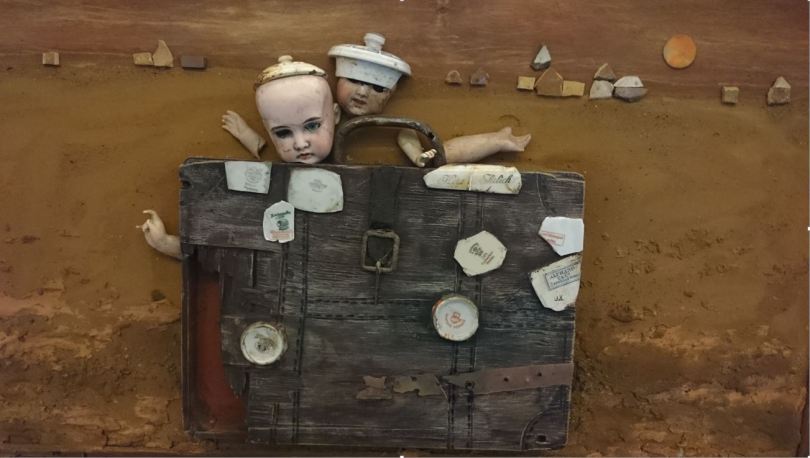
Reisefieber, Jurek Kozieras

Der regionale Aspekt ist also eine treibende Kraft dieser Kreationen, welche in der Tradition von Kurt Schwitters oder auch von Hannah Höch stehen. Die während der sehr langen kommunistischen Ära verdrängte deutsche und jüdische Geschichte der Stadt bekommt durch diese Arbeiten so auch wieder einen Platz im Gedächtnis der heutigen Bewohner, und die Ausstellung seiner Assemblagen stieß vor 17 Jahren in Breslau auf so großes Interesse, dass die Ausstellung dort verlängert werden musste
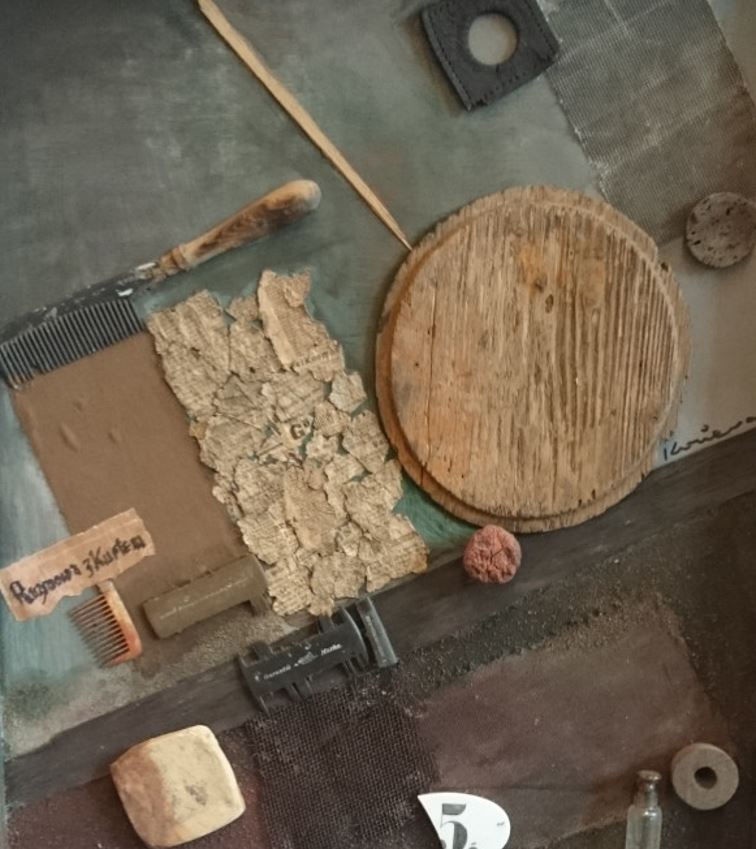
Gespräch mit Kurt, Jurek Kozieras

In einer Zeit, wo eine Vielzahl von Politikern in allen möglichen Ländern wieder eifrig alte Feindbilder längst vergangener Zeiten reaktivieren und pflegen, sind diese Assemblagen im Gegensatz dazu visionäre und sehr komplexe Botschaften einer bei aller gepflegten Tradition auch modernen und aufstrebenden Stadt im Herzen von Europa, heute wird sie Wroclaw genannt.


Lens-Artists Photo Challenge #253 – Fragments


A BIRD AND THE MEAD OF POETRY

The Red necked Phalarope (Phalaropus lobatus) is an extraordinary bird, a real wanderer between worlds and over the misty seas although not really big (length 19 cm). The photo below shows the appearance during the breeding season, in autumn and winter the plumage turns into a simple white / grey. As a great exception in nature, the gender roles of these birds are completely reversed, while the male birds incubate the eggs and then raise the young birds, the female birds perform the courtship dances to attract the male birds, and furthermore they also protect the breeding site against all kinds of external enemies.


Red necked Phalarope in colorful breeding dress,
Photo: U.S. Fish and Wildlife Service

The birds breed from May to July throughout the northern Arctic and subarctic, including Iceland, Sweden, Finland and Norway. During the rest of the year, the birds remain scattered throughout the tropical and subtropical oceans, but can also be found along the coast of Patagonia and in the southern part of Japan. The German name  “Odinshühnchen” is somewhat unusual and refers to ancient northern European mythology.
.

Odin steals the mead of poetry while being pursued by Sittingur, 
Illustration by Ólafur Brynjúlfsson, 17th century

In the ancient European saga collection ‘Edda’, the deity Odin (in the form of an eagle) steals the mead of poetry from Suttungr’s cave. This mead is a magical drink and whoever drinks it can soon recite all the information and solve any question in a flash. While Odin is pursued by Suttungr, he spits the mead of poetry into several vessels. But the chase was so fierce that some of the spit fell backwards. Therefore, everyone could now drink this part, and so poetry was finally given to mankind by a single bird.


Bird watching led by ornithologist Derk Ehlert
on the Poel Peninsula / Baltic Sea in August 2016

In Central Europe, the Red necked Phalarope can rarely be spotted on its way south in August, when it rests in the German coastal region, sometimes also in Austria at Lake Neusiedl. In August 2016, for example, I had the great fortune to see a this bird during an ornithological excursion to the Poel peninsula / Baltic Sea on an inland pond at a distance of about 200 m, because soon afterwards it was time for the birds to set off again quickly for their flight around half the way of our blue planet.


linked to:

Blue whistling-thrush + Bird of the Week invitation XVI

Felsen und Stacheln auf Teneriffa gesehen von Beatrice

Die Hauptinsel des kanarischen Archipels Teneriffa inmitten des wilden Atlantiks ist ein Ort voller Kontraste, sodass es schwer fällt ein Wort für all das zu finden. Geschaffen durch vulkanische Kräfte vor langer Zeit wird das Zentrum der Insel immer noch durch eine riesige, beeindruckende und archaische Caldera bestimmt, aus der sich der höchste Berg Spaniens, der Teide, erhebt. Auf der Insel finden sich auch verzauberte Schluchten aller Art, alte (Wander)wege, schroffe Küsten und steile Klippen, Sanddünen, Halbwüste, subtropische Zonen, Kiefern- und Lorbeerwälder – perfekte Ausgangspunkte für diverse Erkundungen und spannende Wanderungen in den diversen Klimazonen und Biospheren.  Die folgenden Bilder zeigen mehr die expressiven steinigen Aspekte auf dieser so vielfältigen Insel.

Kakteen in der Halbwüste

Schichtungen von Lava


Blick auf den Teide (3718 m) gesehen vom Guajara (2715 m)


Einsames Haus auf dem kargen Land

Spuren der letzten vulkanischen Eruptionen


Klippen der Costa del Silencio bei Ebbe

Atlantischer Ozean bei El Puertito


Farbige Sukkulenten

Am Kraterrand der vulkanischen Caldera


IN HOSPITAL ANOTHER LOST PLACE

Due to a post-traumatic stress syndrome I am actually in a hospital for an adequate treatment. On the premises of the hospital I discovered this morning at 4:45 a.m just another lost place: an old boiler house from early 20th century being no longer in use.


This discovery was accompanied by a lot of birds performing their usual morning concert including one lonesome nightingale. So even in a real crisis astonishing and nice discoveries may be made very unexpectedly and all of a sudden.

MIDWINTER AT QUEBEC / PROFOUND INSIGHTS BY AN ALIEN ABORIGINAL


My name is Lucius-B – a twin from the far away planet Orion-Exo-Delta who was sent to planet Earth to find the first gate to enlightenment. My mission is not easy while my brother Lucius-A is waiting impatiently for my return and detailed report. On my home planet we appreciate to sit around helium bonfires smoking our famous stellar-apple-joints. Then everybody will tell a story about the past and the future, the universe and the multiverse, as well about our eternal journeys through the widths of cosmos because we are the interstellar hijackers who nobody knows. The distance to my home planet is around 5 million lightyears from Earth, this is not too far away because we found a trick to use the power of black holes for travelling. O. K. it is not comfortable in a black hole, quite tight and everything compressed, also a bit chaotic dematerializing but the energies of a black hole are just crazy and will transport you anywhere like a lightning. In former times we also could only stay on our planet but after around 500,000 eons it was a bit boring so our scientists began experimenting successfully with the energy of black holes which transformed our culture early enough. Therefore one of my ancestors could already visit your planet Earth around 1,500 years ago when he met the tribe of the Tolteks in South-America. The Tolteks liked my ancestor and always called him the holy star ghost fallen down from sky. As a special honor for him they constructed in the nearby desert big symbols by placing down on earth stones. I have seen the symbols when arriving at your planet but the Tolteks must have been vanished to another planet because nobody was there anymore. My ancestor was once told by the Toltek shaman that we should come back in around 1,500 years to the Northern hemisphere of this planet during midwinter, then everything would again be very fine and enlightening.

According to the terrestrial calendar the day was the 21 December, so I arrived just in time on this blue planet Earth. But here in Quebec where my navigation system had led me finally everybody was only busy running through all the town while being packed with all kinds of things like a mule starting a very long trip. What is wrong with these people? Is a crisis approaching or one of their stupid wargames so that everybody just takes what is available in the diverse shops to be prepared? Only the children seemed to be happy and were standing in a long queue before a redly strange disguised man with a huge white beard who friendly touched the hands of the children advising them to be always courteous in the coming year. But everybody else was just always busy and would not take any notice of me, so I was wondering whether I really did reach the right location. When the evening approached an elderly married couple saw me loafing around in the streets and finally asked me what I was looking for. If I would have no home, then I should accompany them because their house is really big with plenty of place. We had a nice dinner with turkey and for dessert they served delicious plum pudding. In one of the plum puddings they had placed a coin, so after eating the plum pudding I was lucky to find the coin because that meant a free wish for me. So I wished to find the first gate to enlightenment during this night of midwinter. My hosts firstly did not understand me right enough, but then they explained to me that their prophet found final enlightenment in a desert called Sinai around 2,000 years ago, so maybe I should try the same in a desert.

But then they ignored me completely and placed a rope through the living room where they fixed long socks. I was told not to bring any disorder in the room, but this sock installation really does not look nice so I was quite dazzled. When I asked my hosts for the purpose of the socks they replied that Father Christmas would place nice presents in the socks during the night as an annual ritual to make everybody happy. For my understanding, this proceeding is quite complicated and bizarre: Why did they not just invite this Father Christmas for dinner to receive all the presents because he seemed to be somehow a part of the family. They only laughed and mentioned that Father Christmas is actually very busy – again another busy person – and that he urgently has to take care for his very old wooden slide and his six reindeers pulling the slide, that he is a real old fashioned traditionalist using only wood for heating for example. I did not believe this story because I had not seen any reindeer in the city only a lot of stinky cars creeping over the icy streets of Quebec. So they immediately changed their mind whispering to me cautiously that in case I am truly a nice and kind alien then eventually the spirit of midwinter, called by everybody only Jul the sunny boy, will bring to me this night the book of enlightenment which I can then find next morning in one of my socks. Now, I realized that my mission can be accomplished. Very contently I watched the dark winter sky and searched the radiating Sirius constellation where my home planet can be found. A little bit exhausted after all these weird terrestrial incidents I finally went asleep knowing that my journey had been successful. And as a polite alien I wished in my dreams at night everybody a nice and peaceful holiday season – may the interstellar light always guide you safely through your jungle of life


CAIRO – BEACON OF THE ORIENT

Al-Azhar University, Cairo – postcard of late 19th century


“Places whose names are all forgotten once dominated. For centuries before the early modern era, the intellectual centres of excellence, the Oxfords and Cambridges, the Harvards and Yales, were not located in Europe or the west, but in Baghdad and Balkh, Bukhara and Samarkand.”

from: The Silk Roads, by Peter Frankopan


Calligraphy with verses from the Koran

Cairo derives from the Arabic word El Qahira meaning just superb and glorious city.  Thousands of mosques and the famous Mohammedan University Al-Azhar are to be found on its municipal territory showing that this is one of the most important spiritual centres of Islam since long time. During my visit of the town in 1985 I had the opportunity to visit some of them, a fascinating and mysterious Oriental world with a varied architecture everywhere in the big town.

Visiting the bazaar in the old medina

Mosque of Muhammad Ali, courtyard with old well house

In this regard I have to admit one big mistake as it was really hot in Cairo I did wear short trousers. Not thinking about religious regulations (which are the same in Christian monasteries) one day I wanted to visit a mosque in Cairo, there was a guard at the entrance who stopped me abruptly while pointing on my naked legs. I must have made an impression of real pity because the guard took from a corner a not very clean blanket with which I had to cover my naked legs in order to enter the mosque. I felt really ashamed but the rather pragmatic approach of the guard saved the situation with a rather unusual solution.

Massive pyramidic construction and entrance

The famous Cheops Pyramide on Giza plateau

The day I went to Giza pyramidic complex was cloudy and without any sun. Only few visitors were present on site, good for making photos of the wellknown Sphinx, the stunning  pyramides and the surrounding desert. These are really more constructions for giants of any kind, so the Pharaonic ruling dynasties have left really a creation of eternity. Modern buildings of today would not survive several thousands years like these stony grave-yards.

The ancient Sphinx with pyramide in the background

Besides Cairo is also a very modern town with a terrible traffic I have never seen again. In 1985 there was just one underground line with a few stations, so the many millions of residents were forced to move through their metropolitan town by all means: cars, shared taxis, busses, donkey carts, motorbikes, even camels made their way through this crazy traffic. When I visited Cairo in 1985 around 6 million people lived there what I think is more than enough, but today population has grown to incredible 16 million residents, a real urban moloch.

View from Cairo Tower at a smoggy and dusty day

Street scenery with camels in the very centre

As a resident or visitor of Cairo you have to bear also a rather humid and hot climate while the wind unloads everywhere the sand of the surrounding deserts. Therefore, the view on Cairo from a high tower (see photo above) is not really clear and more smoggy. In the centre of the city I visited of course the big old endless bazaar and the renowned Egyptian Museum being now the home of the Pharaonic mummies and many other phantastic objects and relicts of the old times.

View on old Cairo with its thousands of mosques and minarets

In Cairo my long trip of 1985 through all Egypt from the East to the West, from the North to the South and again back started and ended. And here my fascination for the Oriental world has begun when passing the vast deserts of all kind, the horizon always far away, and then a principal feeling of freedom may stir up suddenly an open mind in wild amazement.


WAR AND PEACE – A GERMAN DILEMMA

If you want peace, you always have to be the one who shakes hands first. (Yitzhak Rabin)


Battle of the Seelow Heights between the Red Army and the German Wehrmacht, April 1945

May 8, 2023 once again marked the anniversary of the victory over German fascism and the capitulation of the entire Nazi rabble, but even 78 years after the end of World War II, this is still not a public holiday in Germany, although it is truly a day of joy of recent European history. Conversely, this means that Germany is still not a normal country, because an official commemorative and public holiday would certainly advance further reflection and an even more in-depth reappraisal of the disastrous history of the 3rd Reich under Adolf Hitler.  And without such proceedings there will be no real reconciliation and peace (even with oneself).

My father in the middle of the non-commissioned officer corps of the “Nachrichten Ersatz Kompanie No. 6” of the German Wehrmacht, Antwerp, December 1942

What is war doing to people? My personal experience is that war, as a taboo subject, generates a great deal of silence about it. My father was never able or willing to talk about his time in the Wehrmacht during World War II. Only my mother gave me a few fragmentary hints about it. So I only know that my father was administratively active behind the front in a supply and logistics unit. In 1942 he already held the rank of corporal, whether he was promoted afterwards is unclear. In any case, he was in Antwerp in 1942 (according to the caption on the back of the photo), and also at some point in Danzig (nowadays: Gdansk) and Riga.

In the photo above he looks quite young and relaxed, you wouldn’t believe this was taken in the middle of WW II. 9 years later he met my mother and by then his hair was already completely gray (and that at the age of 37). Typically, something like this only happens after terrible experiences, but which ones!? I still have so many questions about this, which unfortunately will never be answered because my parents are no longer alive. That’s sad, and at the same time it makes me angry today, because that’s how unresolved war traumata are simply passed on to the next generation.

In West Germany in the 1950s and 1960s everything revolved around consumption and materialism as mechanisms of displacement. Incidentally, the war narrative of the Western Allies (England, USA and France) dominated in West-German public, and even today one prefers not to hear anything about the many millions of dead people and the gigantic damage in the former Soviet Union. However, the Second World War was essentially decided in the East, where the German Wehrmacht was so drastically weakened with the Battle of Stalingrad and then on the retreat that it never recovered from it. And only then, after much bloodshed in the eastern regions of Russia and Ukraine, did the western invasion of Normandy begin in 1944 (Stalin had desperately asked for it much earlier, in vain).

Hence, the British and US Air Forces waged a war of ruthless carpet bombardments against the civilian German population, terror and fear in the style of the German Wehrmacht were now directed against Germany itself. In particular, the carpet bombing of Hamburg and Dresden with tens of thousands of dead civilians are clear war crimes from today’s perspective and no heroic deeds to be proud of. The logic of the victors, however, forbids saying something like that clearly, today that is called collateral damage in a very cynical and nonchalant manner in other conflicts, and all of that is just plain false.

The completely destroyed small town of Lebus (Brandenburg), April 1945

 After all that, Germany is still war-weary until today, there are no magnificent military parades here, because nobody wants to see anything like that here. And the hesitant German policy regarding the current arms deliveries to the Ukraine is precisely the result of this historically conditioned lack of enthusiasm in relation to military matters, and this attitude still drives the former ambassador of the Ukraine Melnyk (now in Kiev) today to irrepressible and raging incandescence, which unfortunately is not very helpful and rather destructive for everyone involved.

The wounds of the 2nd World War have not finally healed, neither here nor in other countries, the 2nd World War with all its heinous terror, monstrosity and all the ruthless crimes committed was just too vampirically evil. The associated moral neglect and eradicated humanity, initiated by the German Nazis, have left their mark on the collective subconscious of Europe, and this sometimes unspoken trauma has not really been processed to this day and continues to prevail, especially in Germany, Poland, Russia and/or Ukraine, because it is well known that these countries also had the most deaths.

A war always has two sides, not just winners and losers, there is always the difference between civilians and the military, and in almost all wars the civilian population has been a preferred, defenseless and raped victim all over the world. Fighting wars is relatively easy, but creating and maintaining peace is the real challenge here and now in the heart of Europe, where Russia’s current barbaric war in Ukraine is raging mercilessly just 1100 km away. If you now think back to the fact that 8 to 10 million people died in Ukraine in World War II, the Ukrainians really need all possible help and solidarity, especially from the German side, so that hopefully there will soon be peace again in their country.

Peaceful land in spring – view on the German-Polish border and the Oder valley near Lebus (Brandenburg), April 2023

MY NEAREST MOUNTAIN – CRAZY TEUFELSBERG IN BERLIN

Today, I would like to introduce you to the mountainous aspects of Berlin. Downtown there are of course some quite higher tops like Kreuzberg and Prenzlauer Berg which make me thinking of the funny film dealing about an English man who climbed on a hill and came down a mountain (that’s also the film’s title).

Postcard with view from Kreuzberg in 1866

But the nearest and more well-known elevation of Berlin is Teufelsberg / Devil’s Mountain in the huge municipal forest Grunewald and just 2 km distant from my home – even with rising sea levels a safe place due to an actual height of unbelievable 120.1 m, a location which also offers an interesting and surprising history.

Deceptive idyll on Teufelsberg in June 2018

Being geologically one of the youngest mountains worldwide, the 50th birthday of the location has just passed by, a critical age where a lot may change usually in the course of times as the following pictures of the site do clearly suggest.


Today Teufelsberg a center of urban art, the very last mutation of a bizarre place.

But let’s see what happened before here. At the end of WW II you would simply find a flat forest and the bombed rests of a big building formerly used by the German Wehrmacht as a military academy. This place was lying in the British sector of (West)-Berlin where no German army was allowed till the early 1990s when the special status of the city ended with the German unification. So nobody had any use for these military ruins left by the Nazis.

Ruins of Wehrtechnische Fakultät at Teufelsseechaussee

Vast areas of the town were also destroyed as a result of WW II, so this was declared as a place where all the debris and rubble of smashed houses would be brought till the late 1960s, in total 26 million cubic meters of waste material piled up to a new mountain getting the name Teufelsberg  because the site is lying at the road Teufelsseechausee leading finally to natural lake Teufelssee.

A truck transporting rubble to Teufelsberg, December 1951

Nature took quickly control of this dump, so today the mountain is covered by a wild nature and secondary forest. And the people of West-Berlin used the new mountain also for leisure like  snow sports as it was difficult to go elsewhere for quite long time due to the Wall of Berlin surrounding them till 1989.

Down the mountain’s not too long slope, December 1981

But the mountain has also been the last listening post of the Cold War. In the years 1968 the American army seized the complete top area of the mountain and erected till 1969 a radar and monitoring station for intelligence purposes such as controlling telephone conversations in the former German Democratic Republic. The secret name of these constructing and supervising ambitions was Project Filman. The last and fifth tower was built and finalized in 1989 shortly before the political transitions and opening of the Wall of Berlin. With the unificiation of Germany this complex was no longer required, the American army left the place in 1991 changing the area to a mere ghost town.

Path around the complex through the secondary forest, June 2018

Pioneer plants conquered the place in the time being which grew in the cracks of the asphalt and even settled on roofs. Undemanding plants such as the evening primrose, the stonecrop or the elder have laid the groundwork that it is today very green on top of the Teufelsberg. The complex was sold to an investor who planned a hotel and luxury appartments on the mountain. But after getting many millions of loan for the project from the banks, he was never seen again in the city. Some years ago this area has also been declared as forestrial land making impossible such luxury projects in the future. 

One of the decaying radiation domes, August 2019

The abandoned and still militarywise fenced place attracted of course the urban art and graffiti community. So in the ruins you find today a vast diversity of amazing colorant works of any kind. The domes can no longer be visited due to their bad conditions, but the unique complex is huge and can be visited against payment of an entrance fee. Meanwhile another change, the city awarded this wild site the relevant status of a real protected monument. So history can be just fabulous sometimes!

Colorful wildness of the ruins, August 2019

MARKS OF ERNEST HEMINGWAY IN WEST-AUSTRIA (1925-1926)

“The world is so full of many things that I am sure we shall be all happy as kings. How happy are kings?” (1)


Mountain path to Kreuzjoch (2,450 m) near Schruns

In summer 2019 we visited again the Montafon Valley for nice and real summerfreshness, this place to be found in the utmost Western part of Austria right to the border of Switzerland. In 1925 and 1926 the still unknown author Ernest Hemingway spent also quite some time here and in fact left lasting personal impressions with the local people.

Hotel Taube at Schruns around 1920 (2)

The budding writer had come to Montafon Valley with his wife and son from Paris, because he had little money and good friends had told him that in Schruns there would be the nice Hotel Taube, that the Montafon was cheap and the mountains just ravishing. Hemingway liked it so much that he spent two winters here in 1924/25 and 1925/26, six months amidst the dazzling white snow world and surrounded by the tranquility he needed to rewrite his first novel “The Sun also rises”. The local people called him the “black Kirsch drinking Christ”, because he liked to stay in the diverse taverns of the valley. 


Ernest Hemingway, John Dos Passos, Gerald Murphy at Silvretta, 1925 (3)

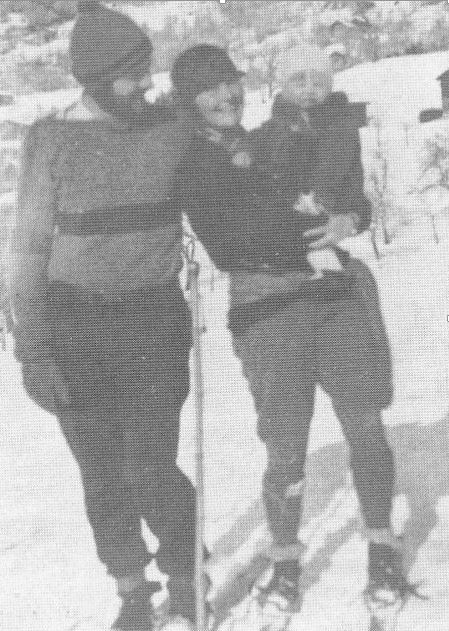
The young author with his wife Hudley and son at Schruns, 1926 (3)

Wiesbadener Hütte at Silvretta in the 1920s, here Hemingway stayed for ski tours (3)

Hemingway, then in his mid-20s, was very fine, on wooden skis and sealskins he climbed up into the Ochsental, climbed the glaciers on the Piz Buin at Silvretta, he loved the mountains, and in Schruns he sipped the homemade schnapps of the peasants, plus lots of Fohrenburger beer, and he beat them all down in the bar of Hotel Taube: the host, his ski instructor Walter Lent, even the local gendarmerie captain participated in the evening poker rounds. Quite how influential those visits to Montafon were for Hemingway gets clear in his last book “A Moveable Feast” because therein he left a memorial to Montafon. So the very last chapter of this book is devoted to this Austrian region, his private paradise, he describes the valley enthusiastically as a real romance.

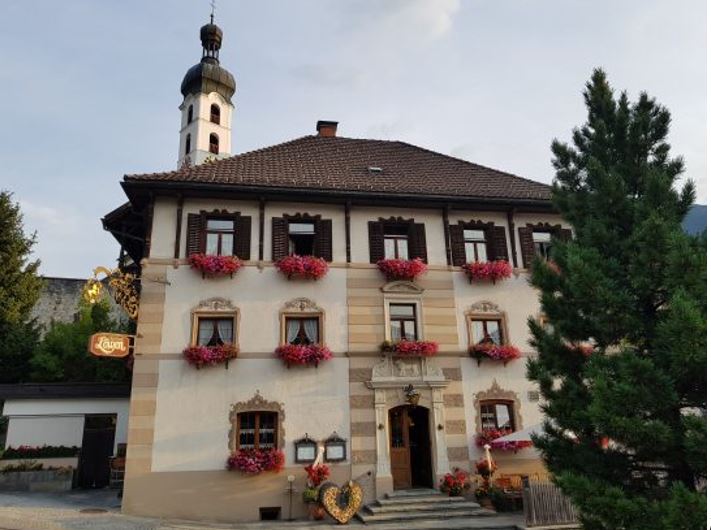
Löwen Tavern at Tschagguns where Hemingway often accompanied hunters and woodcutters

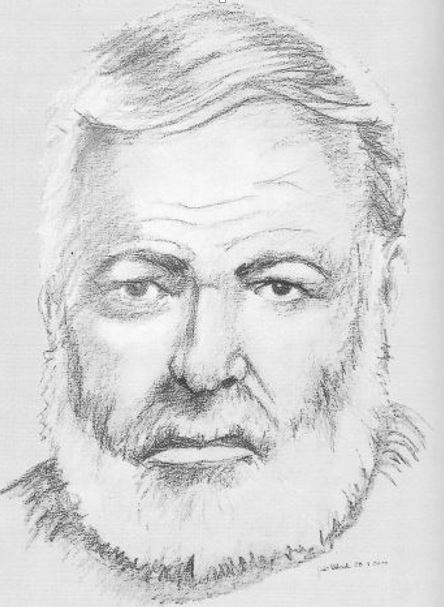
Portrait of Hemingway to be found at Kreuzkeller-Bar in Schruns

And Ernest Hemingway was here in fact a welcomed guest, the people of Montafon really liked him. On the wall of the dining room at Hotel Taube hang today some small black and white photos, Hemingway with beard, Hemingway on skis. John, the writer’s first son, sent it to the hotel himself after visiting the place in his father’s footsteps. Otherwise Hotel Taube makes no fuss over the legendary Nobel laureate, who once resided in this house. A small brass board next to the entrance, which tourism wanted so, and a casual note in the hotel brochure. Not more. No logos, no fussed bar, no Hemingway fuss as to be found elsewhere.

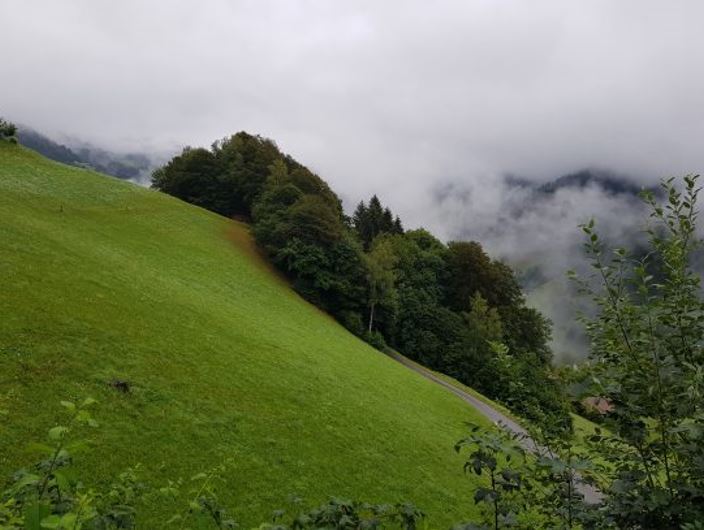
Above the clouds at Innerberg

But Hemingway has become a real myth here, and now his name hangs over the region like the wet-gray clouds moving over the valleys. Even today, the Hotel Taube stands at the church square in Schruns, tidy and neatly the little streets of the small city, and in the background you can still admire today the stunning peaks of seemingly eternal Rätikon waiting for our final discovery.

View on Rätikon from an old smuggler trail leading to the Swiss border

##############

  1. Ernest Hemingway in a letter to his colleague F. Scott Fitzgerald, September 1926
  2. photo from an old marketing flyer of ‘Hotel Taube’
  3. photos from the archive of ‘Montafon Tourismus’